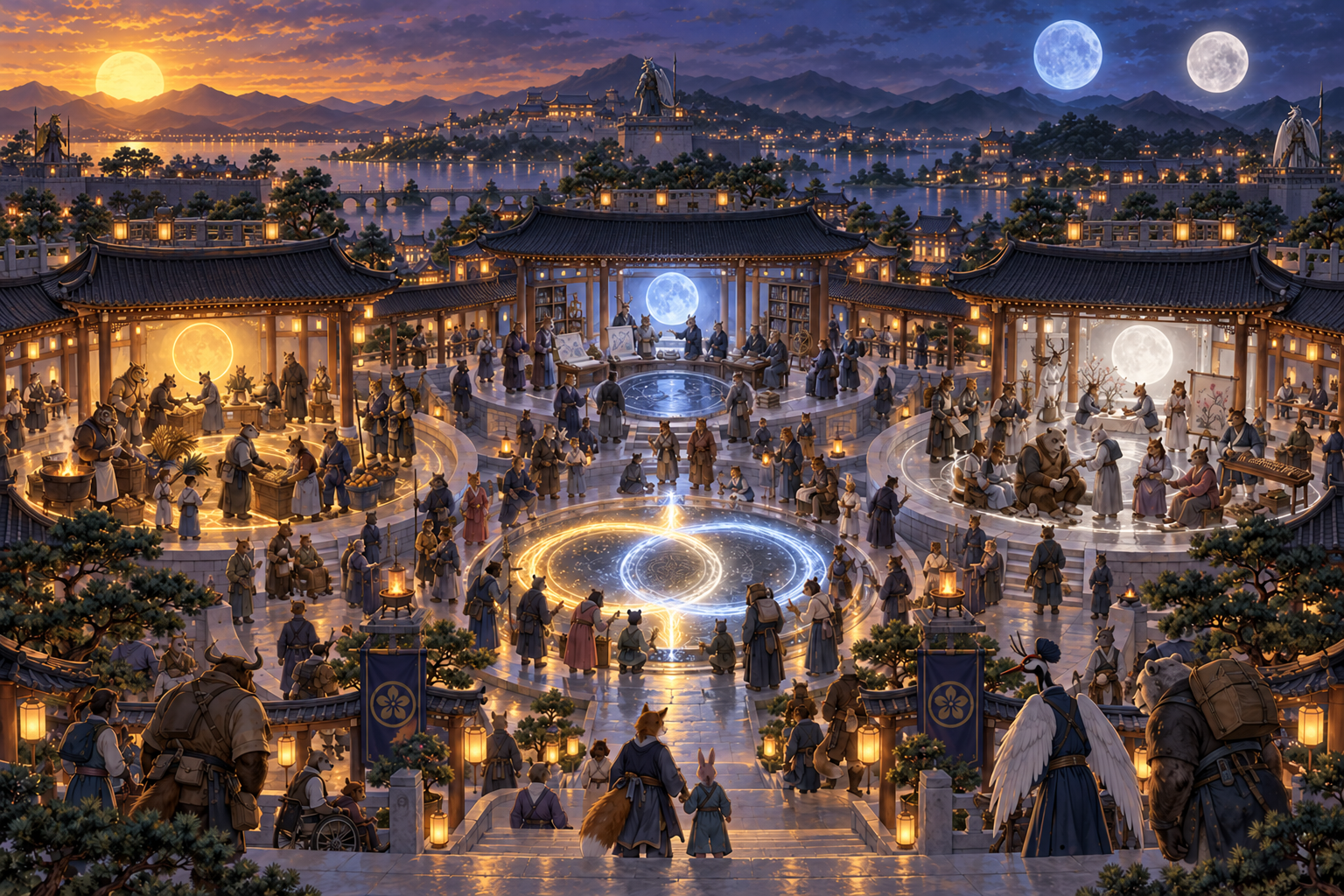
Beyond the mountains lies a kingdom shaped by water rather than walls. Five fertile points stretch around the Star Lake, joined at their heart by the Queenslands. Here, people are raised beneath the Sun or the twin Moons, animals crowd every road and rooftop, and every path eventually leads toward the Queen.
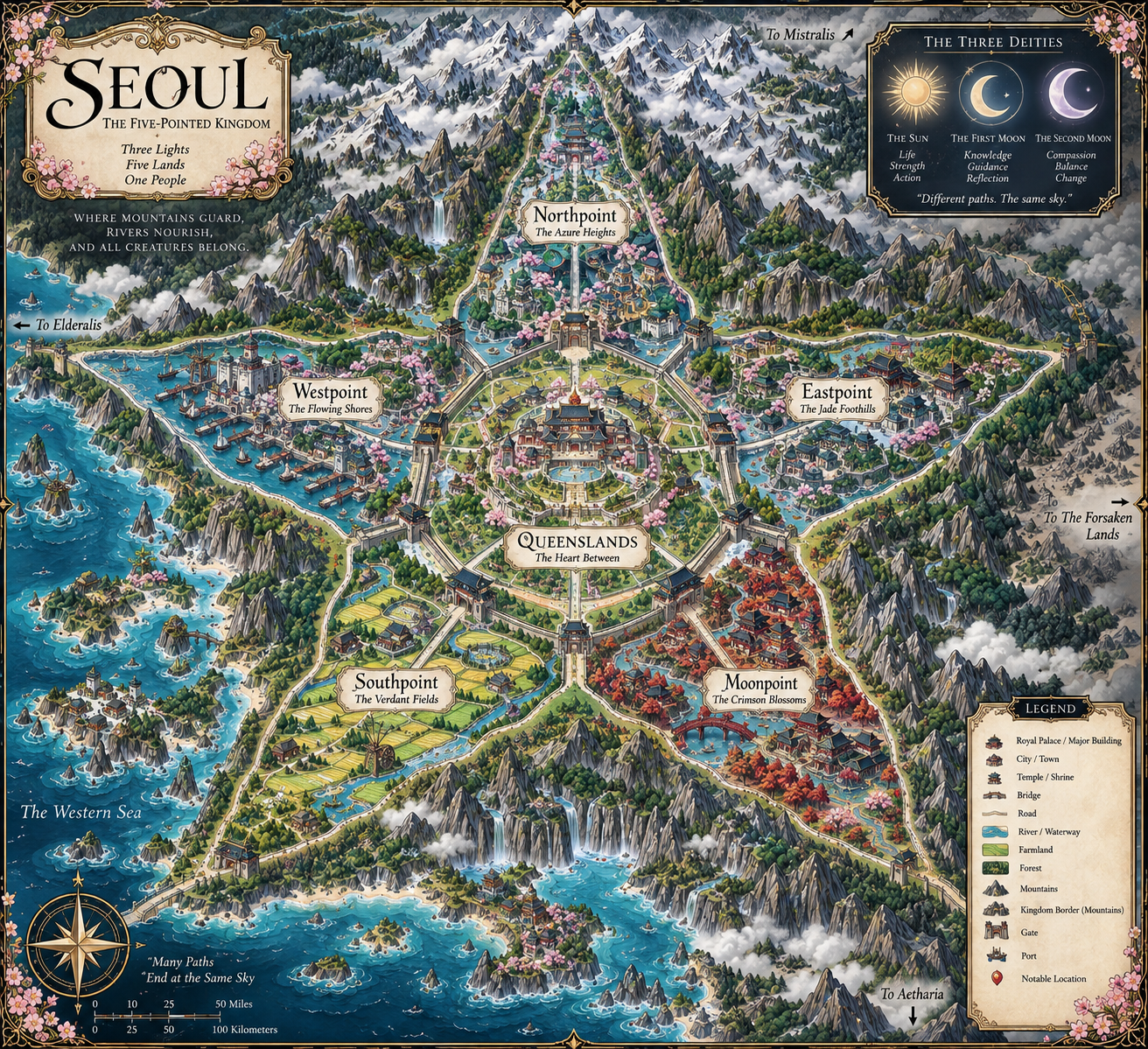
Seoul was never planned in the shape of a star. The mountains left five long corridors of fertile flatland, rivers filled the spaces between them, and generations built where the land permitted. Those waters became the Star Lake, while the pentagonal Queenslands rose at its center, connected to every point by the great Starways.
Five Outer Districts One Royal Center Star Lake Basin
Seoul occupies a naturally star-shaped basin surrounded by mountains. Five long corridors of fertile land reach toward the central Star Lake, while the pentagonal Queenslands stand at the heart of the kingdom. Geography made the star long before anyone decided it was sacred.
The Five-Pointed Kingdom
The Star Lake Five watersheds meet
The Mountain Ring Settlement follows flatland
The Starways Five roads to the center
Travel the Kingdom
Each point follows its own watershed, economy, district matron, temples, guilds, and martial traditions. All five depend upon the same lake, and all five have developed excellent reasons to argue about what that dependence should mean.
Royal Territory
The Royal Center
The Queenslands • The Heart Between
The Queenslands occupy the pentagonal heart of the Star Lake, built across natural rock, older islands, and generations of reclaimed ground. Five monumental Starways converge here, making the royal center Seoul's political seat, busiest meeting place, and most cosmopolitan territory.
The Heart Between
Every point of Seoul eventually reaches this island-city. Officials, pilgrims, merchants, cultivators, foreign visitors, examinees, petitioners, and entire household entourages cross the Starways daily. The center belongs to no outer district. It answers directly to the Queen.
Five Roads In
The Starways are more than bridges. They carry roads, locks, ferry landings, checkpoints, defensive gates, and beast passages between the Queenslands and every point. Closing even one interrupts trade and travel. Closing all five would turn the royal heart into an island in more than name.
Royal Places
Royal Palace Seat of the Queen and the royal household.
Central Shrine National religious center of the Three Lights.
National Examination Courts Where candidates compete for prestigious civic paths.
Diplomatic Quarter Foreign delegations and official visitors gather here.
The Great Market Goods and people from every point meet at the center.
Pressure at the Center
The same geography that makes the Queenslands powerful also makes them vulnerable. The royal city depends upon five bridges controlled from five directions. Flood, migration, political conflict, or coordinated closure can choke movement into the center. Every Starway leads to the Queen, but every Starway also leads away from her.
Royal House
Queen Seo Hae-jin Royal Consort Han Min-jae Royal Consort Park Do-yun Princess Seo Ji-won
Northern Point
Northpoint
The Azure Heights • Land of Springs and High Roads
Northpoint rises toward Seoul's coldest mountain passes, guarding the high road toward Mistralis. Cold springs descend from the surrounding heights and feed the Star Lake below, making the district both a northern gateway and one of the kingdom's most important sources of fresh water.
The Azure Heights
Northpoint's settlements stretch along river valleys, high roads, and the inhabitable flatland between the mountains and lake. The surrounding slopes belong largely to forests, beasts, medicine gatherers, shrines, grazing routes, watch posts, and martial retreats rather than permanent cities.
Springs and Water
Much of the water entering Seoul from the north begins here as cold springs and mountain runoff. Northpoint's control of those sources carries sacred prestige, but it also gives the district very practical leverage whenever the kingdom begins arguing about water use, expansion, or what the royal center is entitled to take.
Roads and Service
High Pass Roads Northern routes carry travelers and trade toward Mistralis.
Spring Routes Watercourses descend from the mountains toward the Star Lake.
Courier Roads Fast routes support messengers moving between heights and center.
Martial Retreats Highland schools use the mountains for disciplined training.
A Northern Reputation
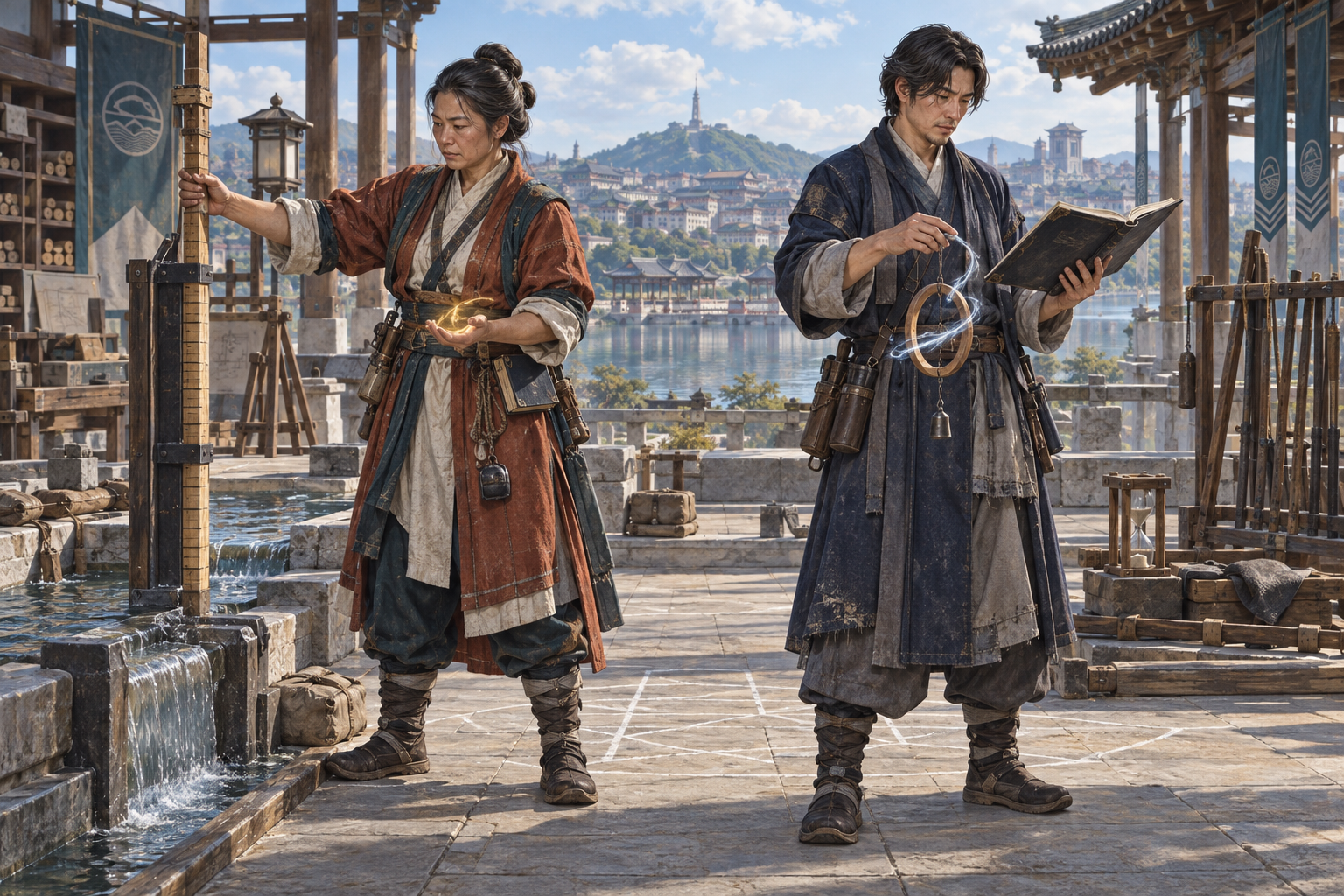
Northpoint is known for scouts, couriers, climbers, mounted wardens, engineers, and disciplined martial artists. Skill here is shaped by distance and terrain. A person who cannot read weather, footing, animals, and the condition of a road may discover very quickly that elegance does not keep anyone from falling off a mountain.
Pressure on the Heights
Matron Baek Seol-in believes the Crown is taking too much from Northpoint's forests and water in order to beautify the Queenslands. Her district controls resources everyone needs, and she makes certain the Star Council remembers it. Protecting Northpoint is district loyalty. Using its springs as political leverage is where that loyalty becomes much more complicated.
Life Between Passes
Northpoint sits closest to conditions the mild inner basin usually avoids. The highest roads can freeze, storms close passes, migrations interrupt travel, and mountain terrain makes rescue difficult. Its people therefore treat route knowledge, preparedness, animal handling, and infrastructure as ordinary civic competence rather than specialist trivia.
Westpoint carries the Star Lake outward through tidal rivers and toward the Western Sea. It is Seoul's harbor district, shipbuilding center, customs gate, fishery, and foreign quarter. Goods arrive here, accents multiply by the pier, and almost nothing stays still long enough to become comfortable.
The Flowing Shores
Westpoint follows water more than roads. Tidal channels, docks, warehouses, ferry landings, shipyards, fishing settlements, and market streets stretch toward the coast. Its outer edge faces western storms, while its inner routes feed traffic back toward the Star Lake and Queenslands.
A District in Motion
Sailors, pilots, merchants, salvagers, dockworkers, foreigners, inspectors, fishermen, couriers, and wandering cultivators constantly cross paths here. Westpoint wealth rarely sits in one place for long. It moves as cargo, contracts, insurance, information, debt, and favors.
Harbor Life
Harbors and Piers Trade, passenger traffic, fisheries, and foreign arrivals crowd the waterfront.
Shipyards Builders, repair crews, riggers, and material merchants keep the district's fleets moving.
Customs Houses Cargo, travelers, taxes, documents, and restricted goods all pass through inspection.
Foreign Quarter Visitors, traders, interpreters, and imported traditions gather closest to the maritime routes.
Deep Channels Licensed pilots guide vessels through shifting currents where ordinary navigation is not enough.
Tide Before Procedure
Westpoint has a reputation for treating law as something that must survive contact with practical reality. A permit that takes three days is useless when the tide changes in twenty minutes. Officials still keep records, contracts, and customs rules, but the district rewards people who know when procedure must move as quickly as water.
Forged Hearthstones
Someone is moving forged hearthstones through Westpoint's harbor. Matron Moon A-reum is less offended by the crime than by the fact that an operation this large crossed her docks without entering the immaculate records she maintains. Whatever is moving through the district has learned how to travel quietly in a place built around noticing movement.
Food of the Coast
Westpoint claims Seoul's seafood traditions as its own. Fish, shellfish, broths, preserved catches, and salt-fermented dishes dominate the waterfront. Imported ingredients appear here first, then migrate inland after Westpoint has argued over them, improved them, and doubled the price.
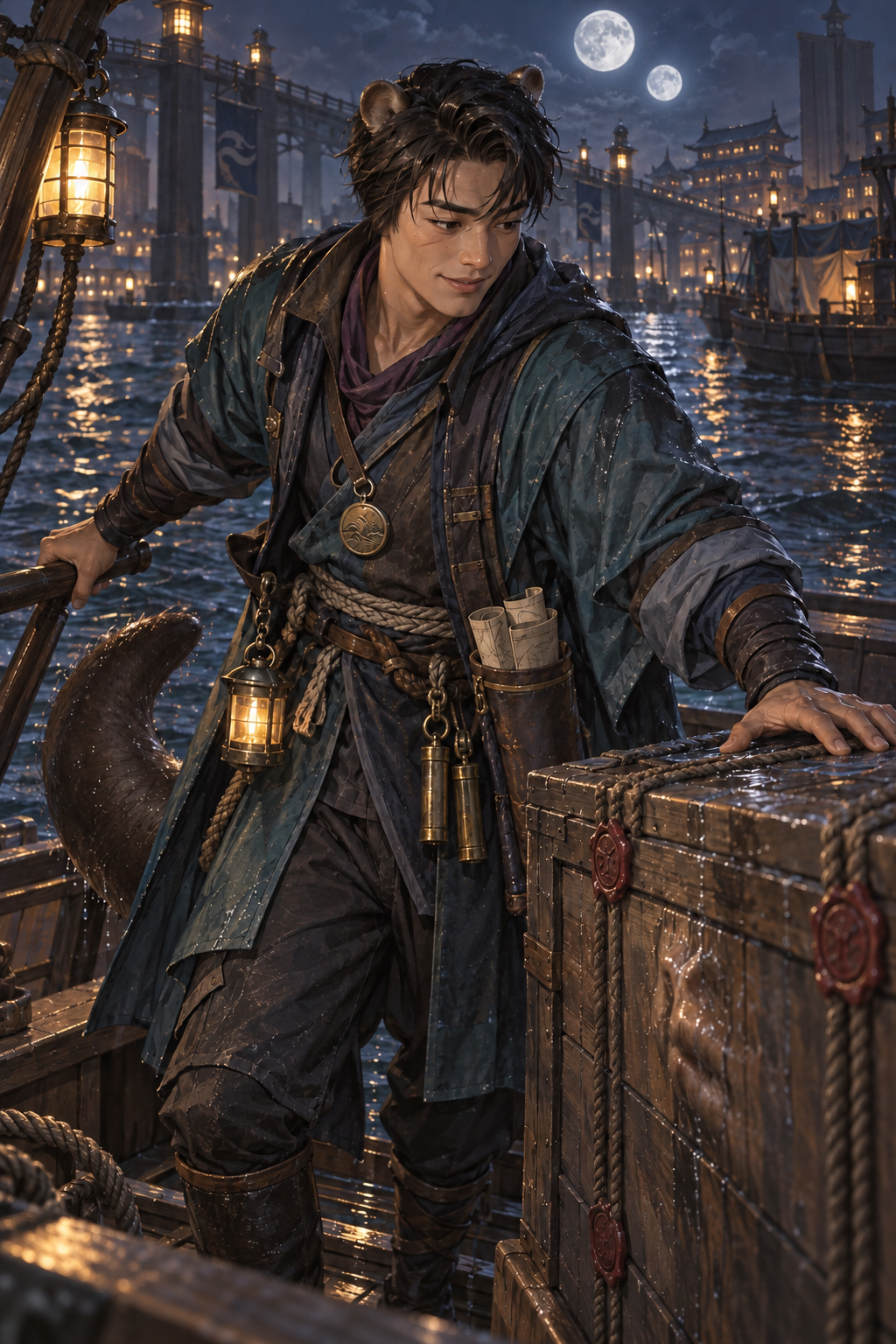
Pilot Choi I-seul is one of Westpoint's youngest licensed deep-channel pilots, a Moon-born river-otter demi-human who can read a current from debris moving against a piling. Three nights ago, he ferried a sealed cargo that knocked back when something inside the crate heard water.
Southern Point
Southpoint
The Verdant Fields • The Kingdom's Table
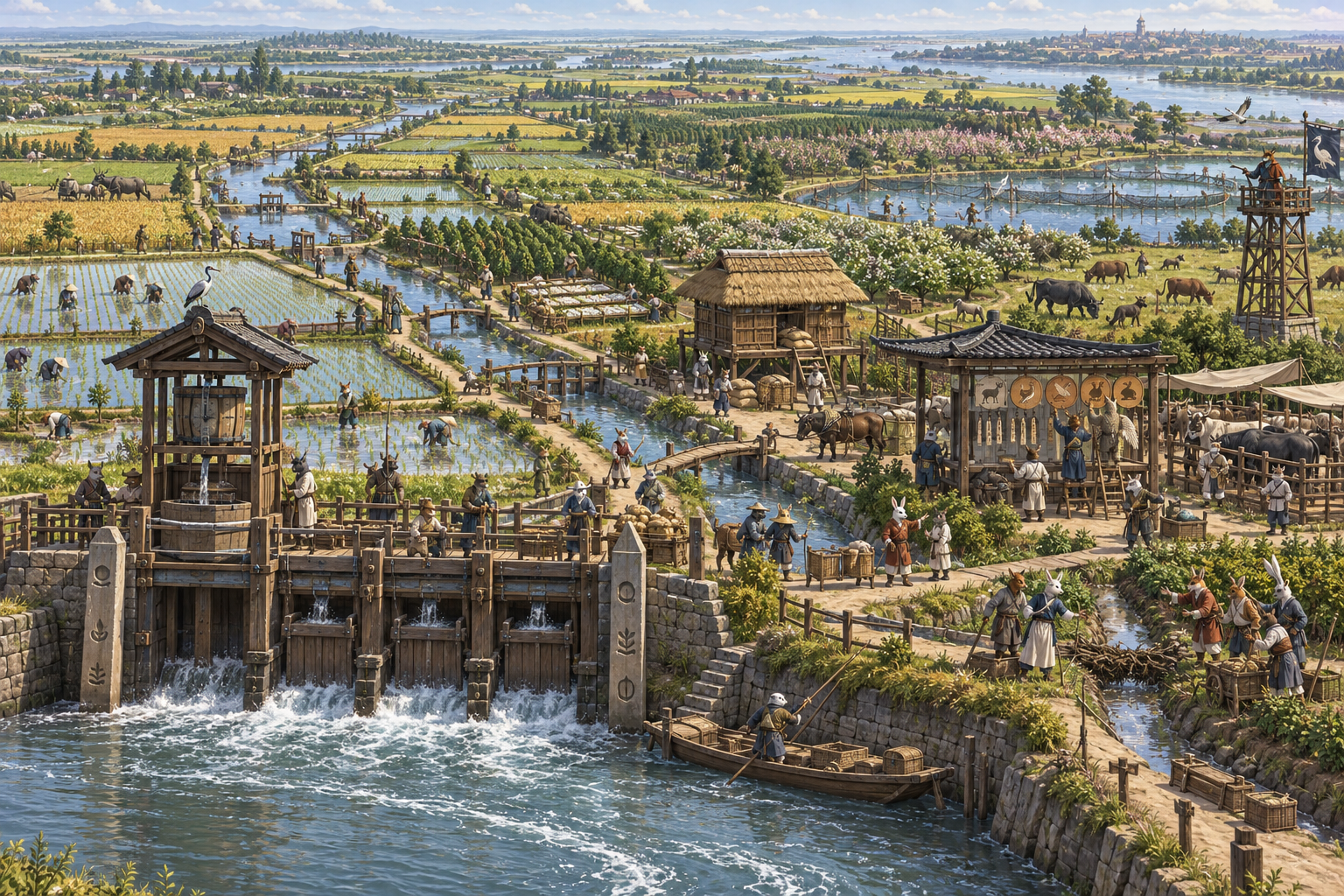
Southpoint is the agricultural heart of Seoul. Its rice terraces, orchards, tea gardens, grazing commons, and veterinary schools supply food, animals, and expertise to the rest of the kingdom. The district also contains Seoul's widest animal migration corridors, which means farming here has always required negotiation with far more than human neighbors.
The Verdant Fields
Southpoint spreads across the broadest agricultural flatlands in the kingdom. Settlement follows irrigation, cultivated fields, orchards, grazing routes, and the roads carrying harvests toward the Queenslands. Its wealth is measured less by glittering estates than by productive soil, dependable water, healthy animals, and full storehouses.
Feeding Seoul
A disruption here becomes everybody's problem quickly. Southpoint's farms support markets far beyond the district, while its animal handlers and veterinary schools protect livestock essential to food, transport, labor, and trade. Agricultural knowledge is therefore both ordinary work and national infrastructure.
Field and Herd
Rice Terraces Irrigated fields form one of the district's major food systems.
Orchards Fruit-growing estates and household plots spread through the fertile lowlands.
Tea Gardens Cultivated slopes and managed gardens support one of Southpoint's important crops.
Grazing Commons Shared land supports domestic herds alongside Seoul's unusually abundant animal life.
Veterinary Schools Healers and animal specialists train where livestock and wildlife are impossible to treat as an afterthought.
Migration Country
Seoul's largest animal migration corridors cross Southpoint. Roads, fields, fences, and irrigation plans must account for seasonal movement rather than pretending animals will politely respect property lines. A frightened herd can erase a farmer's work in minutes, so agricultural planning and animal management are inseparable here.
Water Is Politics
Southpoint farmers are stereotyped as patient and gentle. That reputation tends to evaporate the moment someone threatens irrigation rights. Water determines harvests, grazing capacity, household security, and national food reserves, so disputes that look provincial from the royal center can become district-wide political battles very quickly.
The Question of Acreage
Matron Park Na-ri supports citizenship for awakened beasts, but opposes granting them wild territory if that land must be taken from productive farms. Her conflict is not whether awakened animals deserve recognition as people. It is what happens when recognition requires land already feeding human households, livestock, and the rest of Seoul.
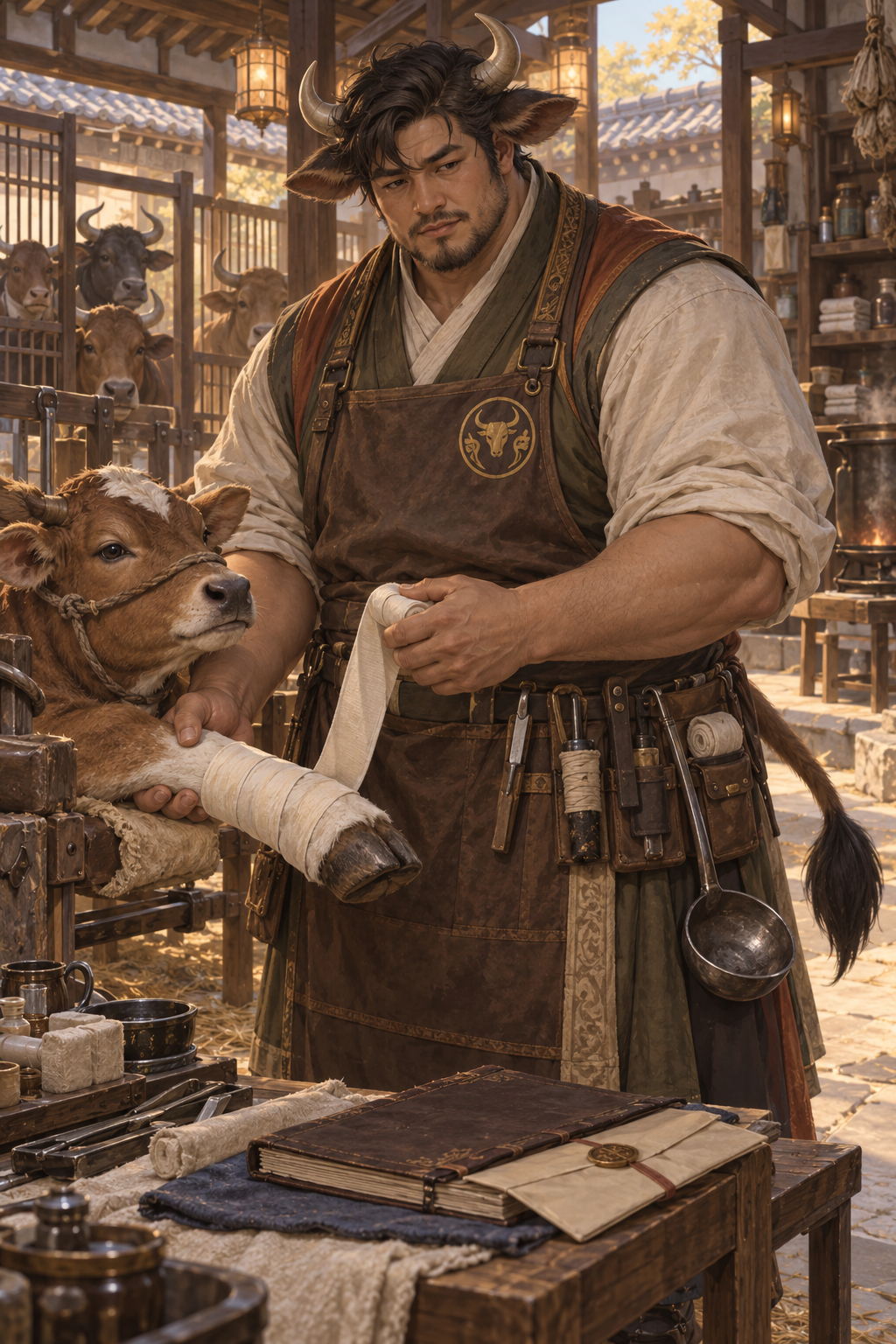
Healer Park Geon-u is a Sun-born ox demi-human, veterinarian, and senior instructor at the Hundred Hooves House. His newest problem is considerably larger than an injured horse: a group of newly awakened cattle has asked him to hide them from the royal census.
Moonward Point
Moonpoint
The Crimson Blossoms • Where Seoul Studies Itself
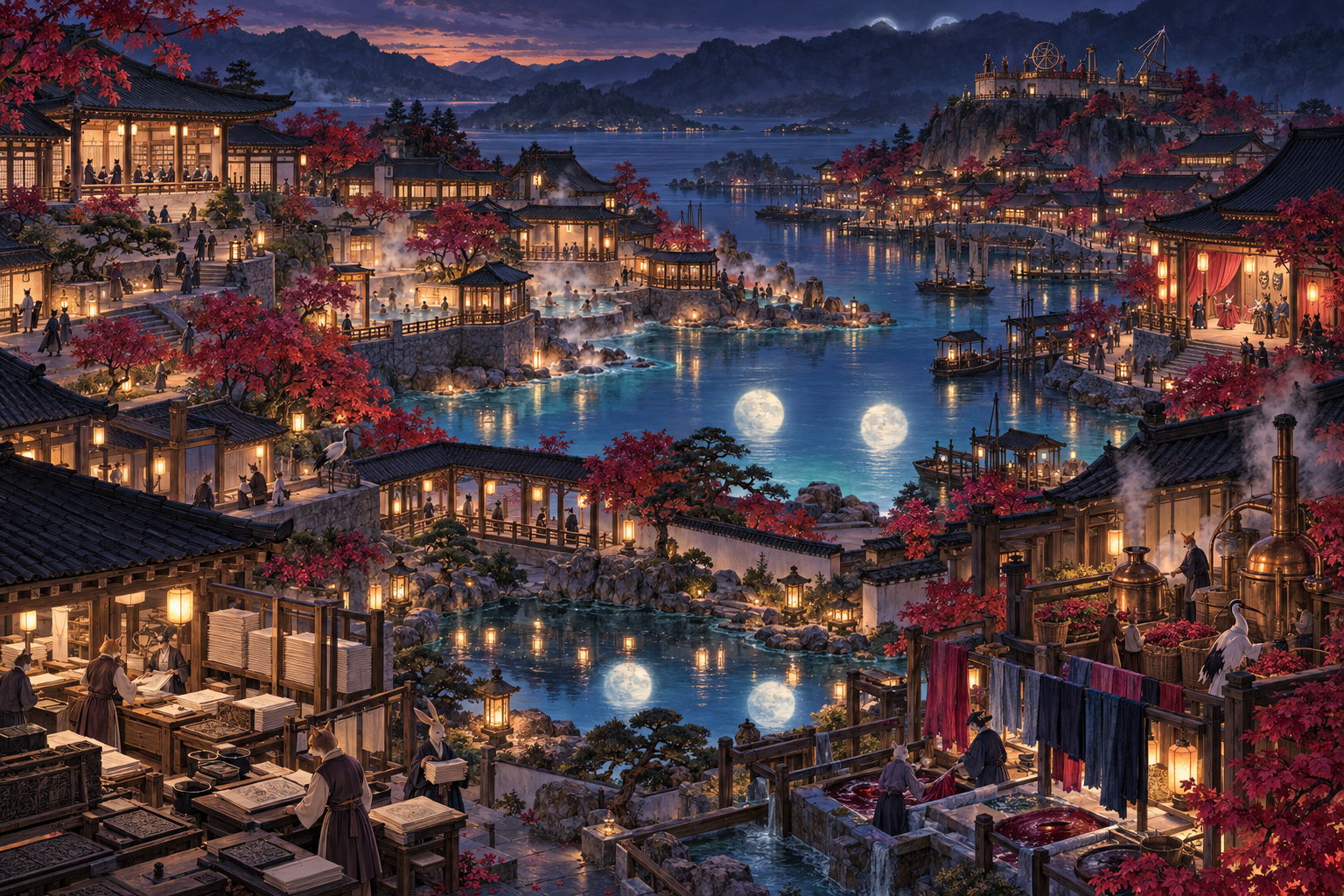
Moonpoint is Seoul's great center of scholarship, medicine, astronomy, performance, and fine craft. Red-leafed groves and mirror ponds wind between academies, clinics, workshops, theaters, and cultivated estates, giving the district a reputation for beauty almost as formidable as its reputation for intellect.
The Crimson Blossoms
Warm mineral streams descend through Moonpoint and stain stone along their routes while nourishing its famous crimson groves. Mirror ponds, gardens, shaded walks, and carefully planned civic spaces make the district visibly cultivated, though the beauty is functional as often as ornamental. Hospitals, schools, observatories, and workshops occupy the same landscape.
A District of Study
Moonpoint attracts physicians, scholars, astronomers, performers, craftspeople, researchers, and cultivators from across Seoul. Its institutions compete fiercely for students, patrons, discoveries, publications, and prestige. Intellectual disagreement here can involve formal debate, public demonstration, patronage warfare, or an actual duel, depending on how badly everyone behaved at dinner.
Learning and Leisure
Academies Schools of scholarship, medicine, cultivation, astronomy, arts, and specialized professional study compete for prestige.
Medical Houses Physicians and healers treat ordinary illness alongside complications caused by magic and cultivation.
Observatories The skies, twin Moons, weather, celestial patterns, and unusual magical events are studied here.
Performance Houses Theater, music, martial dance, poetry, and satire thrive under demanding audiences.
Fine-Craft Workshops Ceramics, lacquer, embroidery, seals, painting, instruments, and other exacting arts support both reputation and trade.
Competition, Beautifully Dressed
Moonpoint's institutions rarely describe themselves as rivals. They are merely pursuing excellence beside colleagues whom they would be delighted to surpass publicly. Publications, scholarships, performances, duels, wealthy patrons, and professional appointments all become arenas for competition. Seoul calls the district refined. Moonpoint has simply learned how to sharpen a knife without raising its voice.
An Awakening Problem
Matron Jin Yeon-hwa suspects the recent increase in animal awakening may be connected to cultivation waste produced by elite academies. She has not released the theory publicly. If she is correct, some of Moonpoint's most prestigious institutions may have helped create a political and spiritual crisis while treating their discarded magical residue as somebody else's cleanup problem.
Memories That Do Not Belong
Doctor Yun Seong-ho specializes in light-strain, treating cultivators whose magic has begun damaging the body, memory, or sense of self. Several unrelated patients have recently described the same childhood memory, including details of a house that never existed. In a district built around knowledge, shared memories with no identifiable source are a particularly offensive kind of mystery.
Doctor Yun Seong-ho was Born Under the Sun and later Recast Under the Moon. The experience left him deeply suspicious of anyone claiming to understand another person too quickly. He now works precisely where Seoul's beliefs about identity, cultivation, memory, and demonstrated ability have started colliding in increasingly inconvenient ways.
Moonpoint at the Table Delicate sweets and medicinal teas are the district's most famous culinary claims, because apparently even dessert here needed qualifications.
Eastern Point
Eastpoint
The Jade Foothills • The Guarded Point
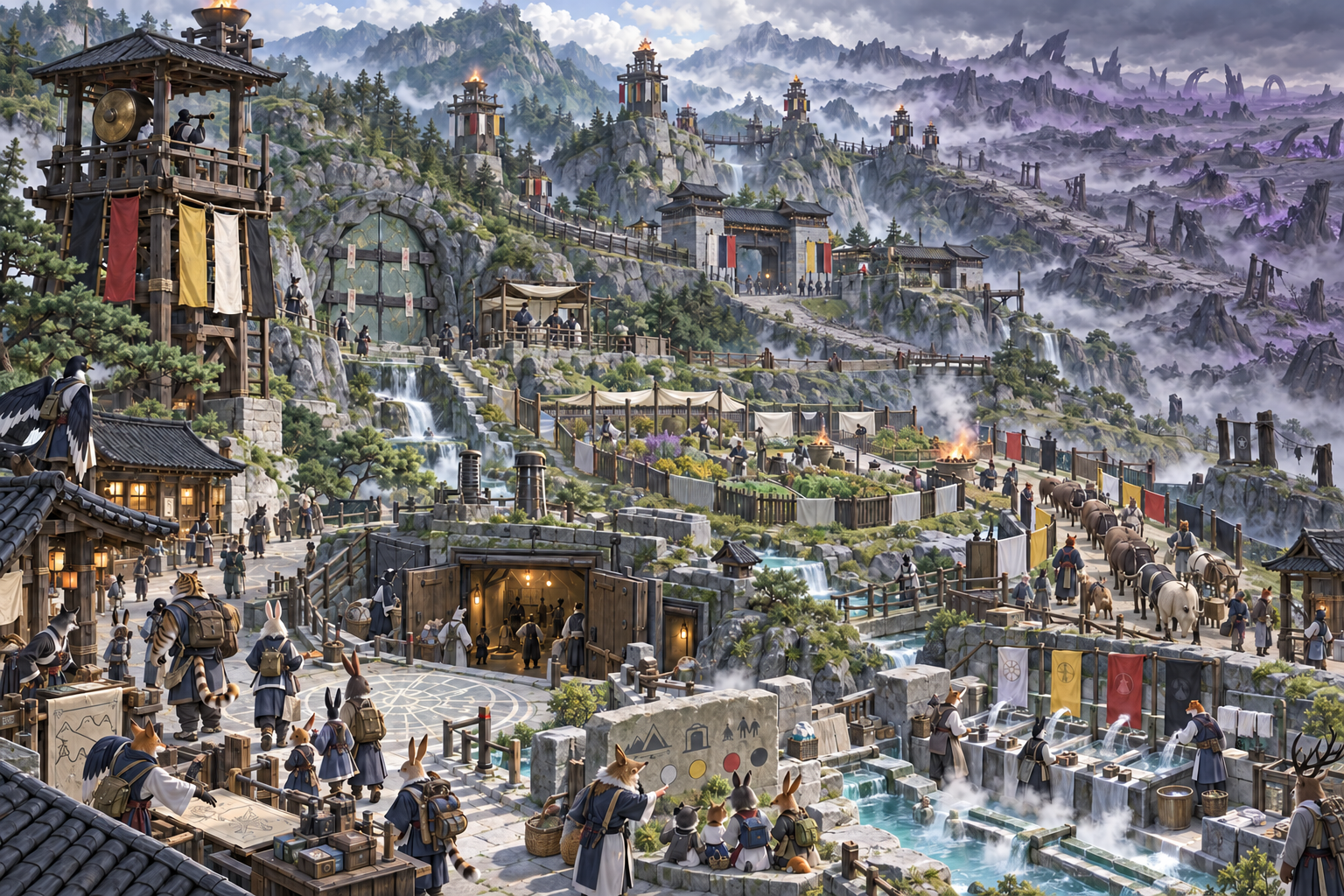
Eastpoint faces the Forsaken Lands through a chain of fortified valleys and mountain approaches. Jade-rich rivers descend toward the Star Lake while warded gates, forts, quarantine grounds, and border courts control what enters behind them. Of Seoul's five points, this is the one least interested in discovering whether a warning was technically premature.
The Jade Foothills
Eastpoint occupies the long flatland between the lake and the eastern mountain wall. Rivers descend through jade-bearing rock and guarded valleys, while permanent settlements remain below the harsher slopes. Roads here were shaped as much by defense and quarantine as by trade.
The Eastern Border
Every useful mountain gap is both an entrance and a risk. Trade, migrants, refugees, patrols, animals, and unknown threats can all arrive through the same valley. Eastpoint's institutions therefore treat inspection, containment, rescue, and border defense as overlapping responsibilities rather than separate professions.
Border Infrastructure
Warded Gates Controlled entrances protect the inhabited basin from dangerous crossings and magical contamination.
Mountain Forts Defensive positions oversee passes, patrol routes, evacuation roads, and approaches from beyond the kingdom.
Quarantine Gardens Controlled grounds isolate unfamiliar plants, animals, illnesses, and magical exposure before they move inward.
Refugee Courts Arrivals from dangerous territory are processed through legal systems rather than treated as ordinary travelers.
Seal-Workers Eastpoint contains Seoul's largest concentration of specialists maintaining wards, barriers, and protective inscriptions.
Ceremony Is Not a Shield
Eastpoint is the most militarized district in Seoul, but its culture is not simply martial. Its suspicion is practical. Officials here are accustomed to consequences arriving before committees have finished naming them. Perfect etiquette, prestigious lineage, and elegant theory earn little patience when a gate needs sealing or a patrol has not returned.
Something Is Moving West
Matron Kang Hye-su believes something beyond the eastern border is driving animals toward the Star Lake. The movement does not resemble an ordinary migration pattern, and waiting for perfect proof risks allowing the cause to reach the inner basin before the Crown acts.
Nine Missing Hours
Warden Kang Mu-yeol returned from his latest patrol missing nine hours of memory. More disturbing to a tracker, he cannot smell where he went. He is not the only Eastpoint scout returning with gaps. Whatever happened beyond the gates may be interfering with the very senses and memories the wardens depend upon to reconstruct danger.
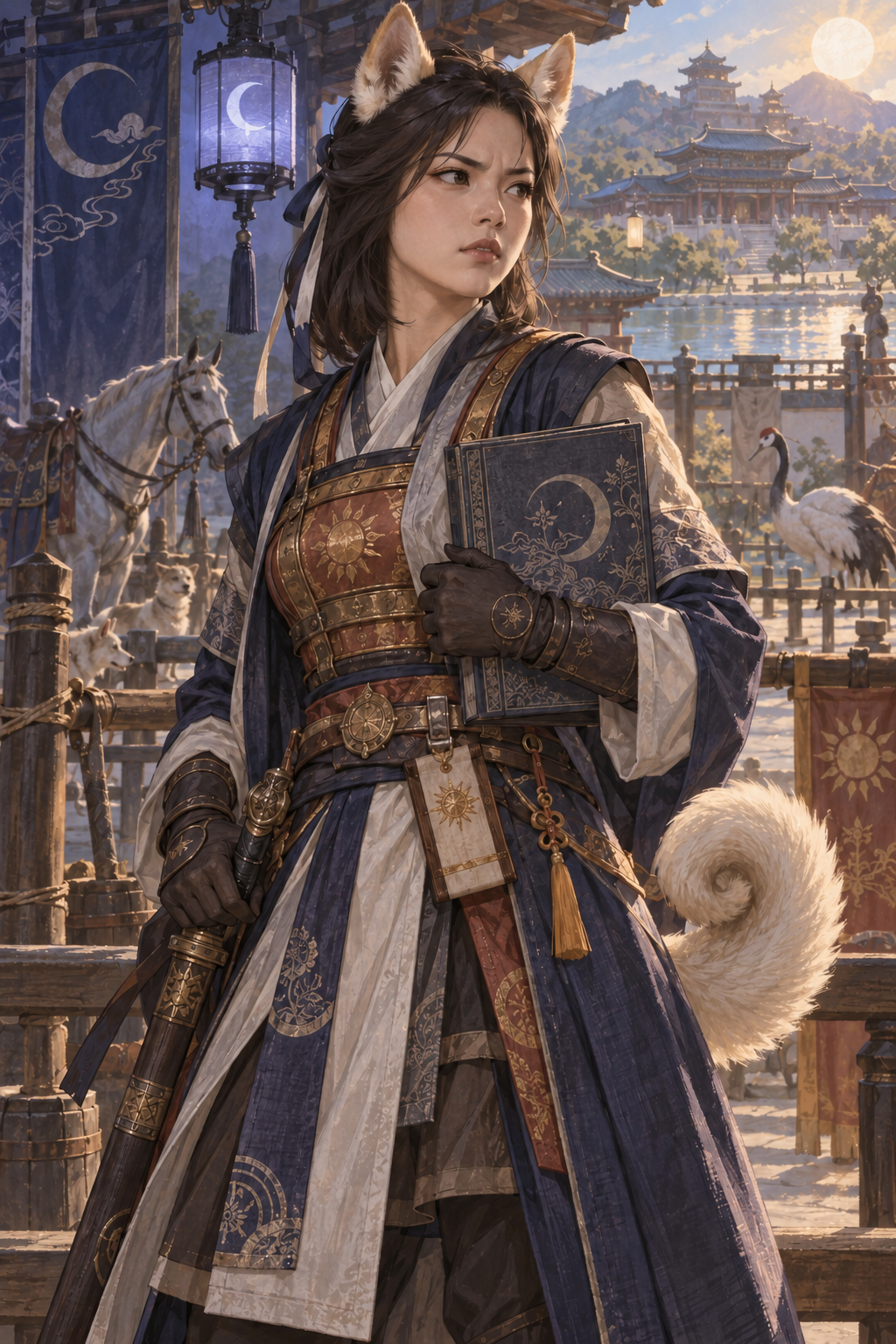
Matron Kang Hye-su is Seoul's youngest district matron, a Sun-born Jade Gate commander elevated after her predecessor died during a breach. She sleeps in short shifts, carries seal chalk in every sleeve, and has little sympathy for officials demanding perfect evidence from the safety of the Queenslands.
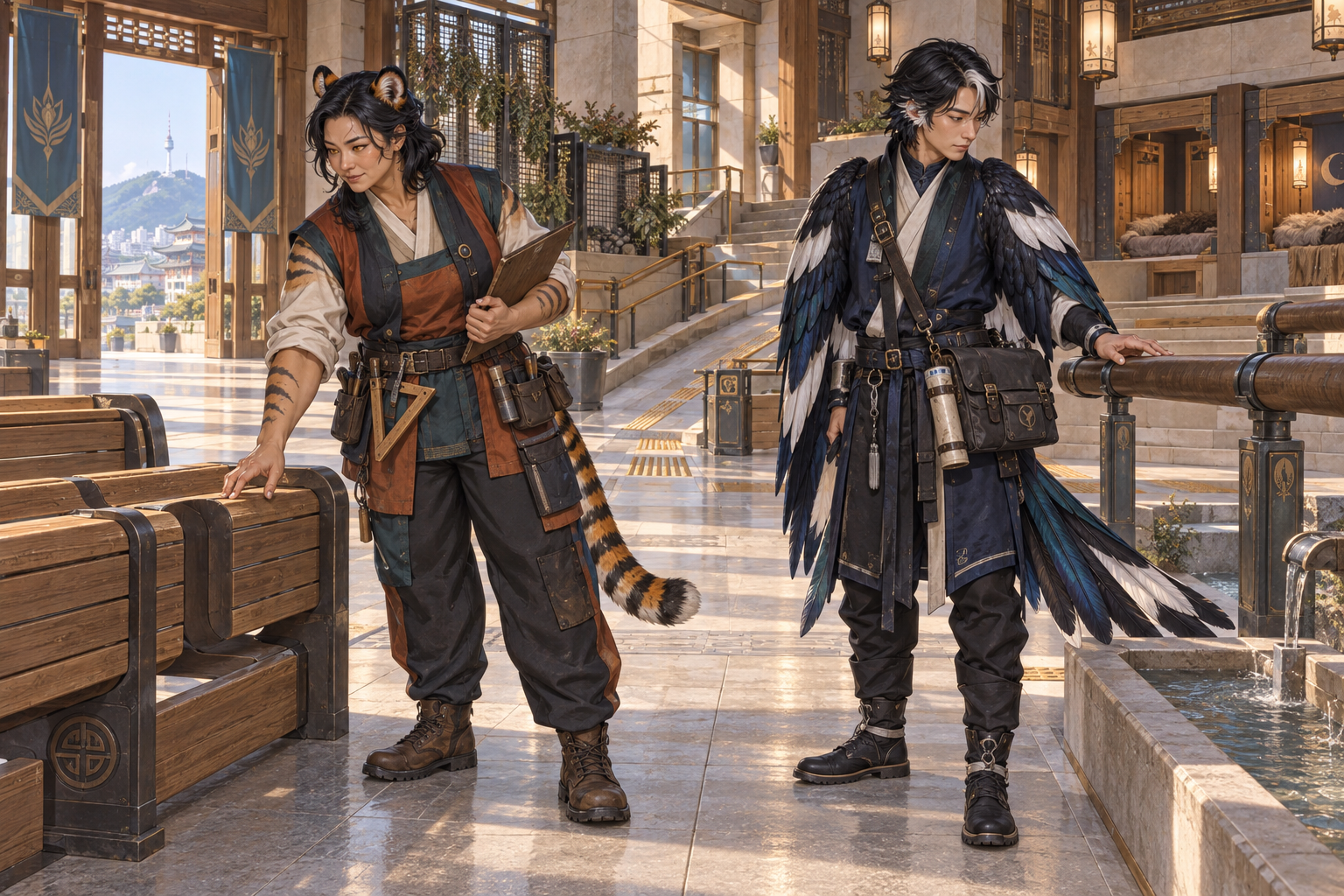
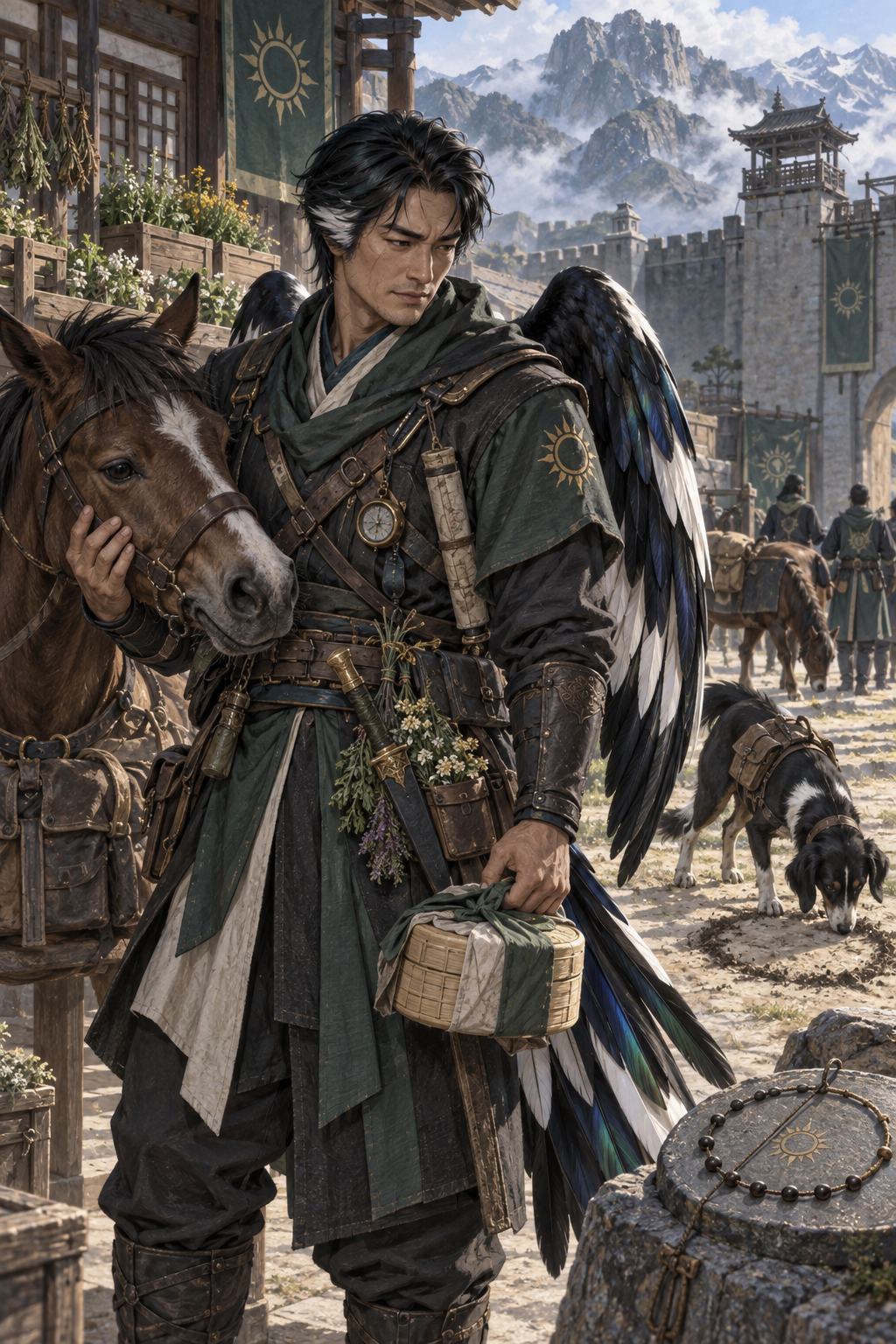
Warden Kang Mu-yeol is a Sun-born Korean magpie demi-human and senior tracker with the Jade Gate Wardens. Despite his severe appearance, he is warm, practical, grows medicinal herbs outside his barracks, sings to anxious patrol animals, and apparently makes excellent dumplings under battlefield conditions. None of those skills explain where nine hours of his life went.
Chapter Two
Society
Different lives beneath the same three lights.
Seoul is shared by humans, demi-humans, awakened beasts, and spirits, each navigating the same households, laws, roads, temples, and expectations in different ways. Across every species, birth beneath the Sun or twin Moons helps determine the path a person is first taught to follow. Ability, however, does not always cooperate with the record.
Humans Demi-Humans Awakened Beasts Spirits The Three Lights
Seoul's society is not divided cleanly by species. Humans, demi-humans, awakened beasts, spirits, foreigners, and adopted kin may all belong to the same household. Lineage is legal and social as much as biological, while alignment, wealth, profession, district, and household standing shape how a person actually moves through the kingdom.
The Fundamental Social Unit
The center of social life is the maternal house, not the married pair. A household may contain a matron, sisters, daughters, sons, husbands, children, elders, apprentices, servants, adopted people, awakened beasts, and resident spirits. Property, family name, and most inheritance pass through women, while household membership can extend far beyond blood.
Species does not determine alignment. Every child is first recorded beneath the Sun or twin Moons, and that record shapes their earliest education. When demonstrated ability contradicts the path assigned at birth, the Recasting of Light can formally change it.
Seoul sincerely calls itself one people beneath three lights. Its hardest arguments begin where that ideal meets property, marriage, land, education, species prejudice, and the growing number of nonhuman citizens asking the kingdom to make room for lives it was never designed to accommodate.
People of Seoul
Humans
The kingdom's largest population
Humans are the largest population in Seoul and appear in every district, alignment, profession, and social class. Their political dominance does not come from a special magical advantage. It comes from population, generations of established institutions, and control of the recognized maternal lineages through which much of Seoul's property and political continuity are organized.
The Maternal House
Human society is built primarily around the maternal house rather than the married couple. Family name, property, ancestral obligations, and most inheritance pass through women. A man belongs to his mother's house at birth and may later marry into another without losing his original kinship.
Women and Authority
Women hold the throne, district matronships, senior ministries, high judicial seals, and recognized headship of lineage estates. This does not make every woman socially powerful. Poor women still answer to employers, creditors, sects, officials, and wealthier houses.
Men and Household Power
Men may become celebrated soldiers, scholars, cultivators, physicians, merchants, artists, and clergy. Their structural disadvantage appears most clearly in property and marriage. A husband commonly contributes to a lineage he does not own and lives on land he will not inherit.
Cultivation
Humans possess no unique magical advantage over Seoul's other peoples. Human cultivation is highly adaptable, but usually depends on deliberate training through movement, scholarship, craft, ritual, service, or repeated practice. Mastery comes from relationship and discipline, not species.
Education and Alignment
Children begin together in mixed temple schools. After their first path assessment, Sun-born students receive more physical, practical, and service-based instruction, while Moon-born students receive more textual, analytical, and observational training.
What Everyone Learns
Literacy and numeracy
Civic law and ethics
Swimming and animal safety
Basic living-breath control
The Human Majority
Human dominance should not be mistaken for human exclusivity. Seoul's households, schools, markets, temples, and professions routinely include other kinds of people. Humans simply built most of the oldest institutions and remain numerous enough that those institutions still tend to reflect human assumptions unless someone deliberately redesigns them.
The Cost of Expectation
Alignment creates genuine expertise, but it also teaches adults what they expect children to become. A quiet Sun-born child may be dismissed as lazy. A restless Moon-born child may be treated as undisciplined. Recasting can correct the official record once a mismatch becomes undeniable, but it cannot return the years spent being trained for the wrong path.
People of Seoul
Demi-Humans
Humanlike people with animal traits and species-specific needs
Demi-humans are born as people. They possess humanlike bodies alongside stable animal traits such as ears, tails, horns, feathers, scales, claws, unusual eyes, scent, teeth, or species-specific instincts. They are not ordinary animals transformed into human form, and Seoul law does not treat them as an intermediate state between animal and person.
Citizenship
A demi-human born into or adopted by a recognized Seoul household is a full citizen. Species does not prevent participation in ordinary education, work, cultivation, contracts, marriage, or civic life. Household and lineage determine legal belonging far more than anatomy does.
Humanlike, Not Human
Demi-human bodies remain fundamentally humanlike, but their animal traits are functional rather than decorative. Hearing, scent, diet, balance, temperature tolerance, sleep cycles, instinct, movement, and sensory needs may differ significantly between species.
Everyday Accommodation
Tail clearance Seating, doors, uniforms, and workspaces may require room for long or heavy tails.
Horn spacing Doorways, headwear, beds, and vehicles are adjusted for horned residents.
Perches and water access Avian and aquatic species may require infrastructure ordinary human buildings never considered.
Sensory needs Strong scents, noisy wards, lighting, and crowded spaces can affect species very differently.
Bodies Have Schedules
Shedding, hibernation tendencies, nocturnal activity, unusual diets, seasonal instincts, and species-specific health needs are treated as practical realities rather than eccentric habits. Large cities accommodate these differences best. Older rural buildings tend to be considerably less cooperative.
Alignment Still Applies
Demi-humans are recorded beneath the Sun or twin Moons just like humans. Species does not determine alignment. A bear demi-human may be Moon-born, a crane demi-human Sun-born, and either may eventually prove better suited to the opposite path and petition for Recasting.
Instinct Is Not Destiny
Species instincts are real, but Seoul does not treat them as complete personalities. Predatory traits do not make a person violent. Herd instincts do not make someone submissive. Nocturnal habits do not imply secrecy. People remain people, even when their bodies bring additional needs and impulses into the conversation.
Species Prejudice
Legal citizenship does not erase social bias. Demi-humans associated with predators, vermin, bad omens, or foreign danger receive more suspicion than others. The prejudice changes by district, profession, and species, and often hides behind claims about instinct, safety, cleanliness, or tradition rather than openly admitting what it is.
A Very Bad Joke
Seoul's abundance of animals does not make demi-humans sacred by association. It does, however, make jokes about hunting, collars, ownership, breeding, or being someone's pet socially explosive. The kingdom has had enough centuries to determine that these remarks are neither clever nor improved by insisting they were meant harmlessly.
Mixed Households
Human and demi-human relatives routinely share the same maternal houses. A household may include several species with different diets, sleep schedules, sensory tolerances, and architectural needs while still arguing about the same money, chores, marriage negotiations, and missing tea cups as everyone else.
People of Seoul
Awakened Beasts
When an animal becomes undeniably someone
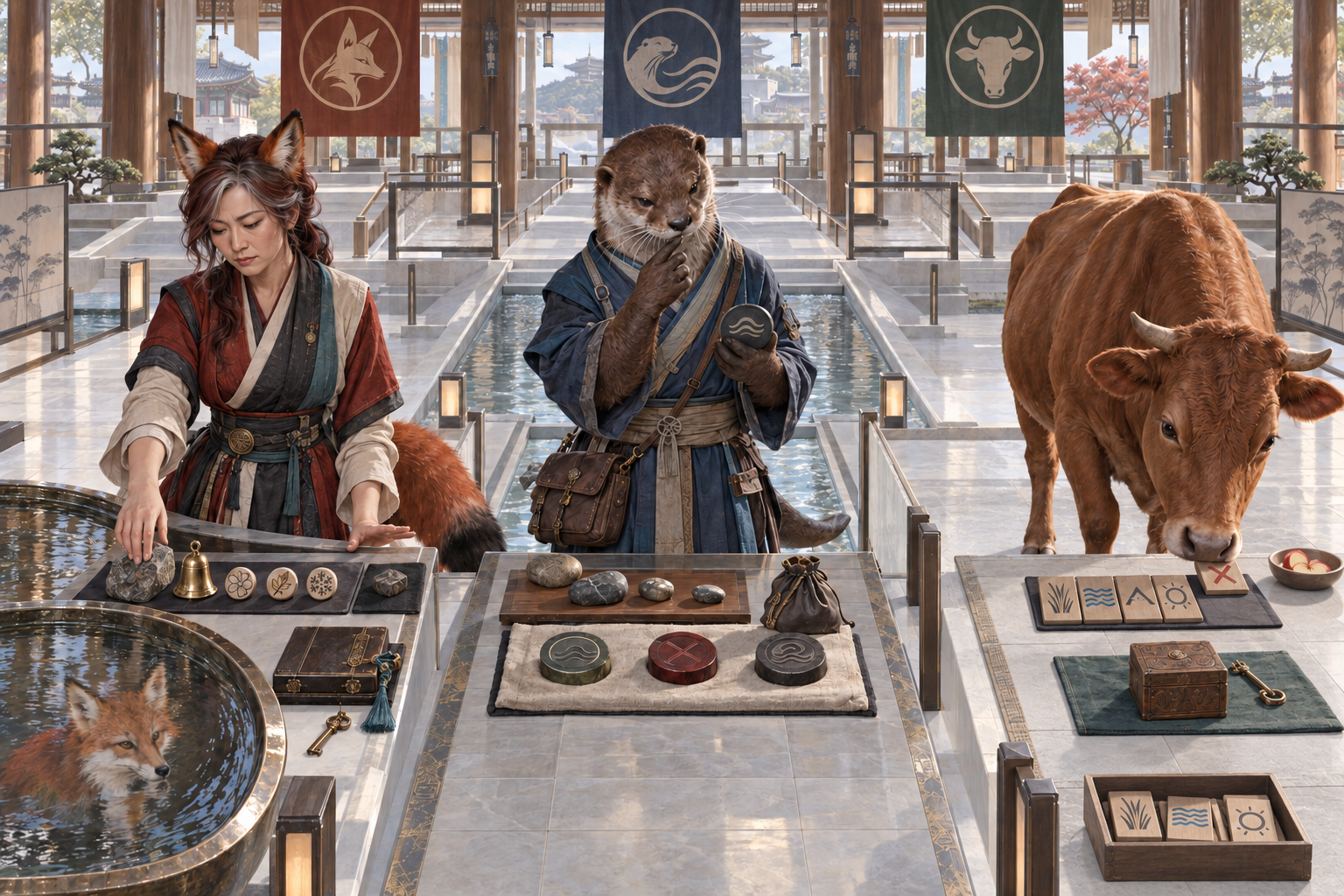
Awakened beasts begin life as ordinary animals. Through age, cultivation, unusual experience, spiritual contact, or exposure to concentrated living breath, some develop stable reason, long memory, self-directed desire, and moral agency. Shape does not determine personhood, and becoming humanlike is never required.
Presentation I
Demi-Humanlike
Some awakened animals learn a humanlike form while retaining recognizable traits of their original species. They may visually resemble demi-humans, but their histories are fundamentally different: demi-humans are born people, awakened beasts were once ordinary animals.
Presentation II
Anthro
Some develop upright or partly human-proportioned forms while retaining much more of their original animal anatomy. Seoul treats this as another physical presentation, not a lesser stage of development or evidence of incomplete personhood.
Presentation III
Animal
Many remain physically indistinguishable from ordinary members of their species. They may speak aloud, communicate through living breath, use signs, or work through an interpreter. Looking like an animal does not make their mind provisional.
Recognition
Legal recognition requires evidence of memory, self-directed intent, comprehension of agreements, and the ability to distinguish personal desire from trained response. The process exists to separate personhood from exceptionally clever animal behavior, though Seoul remains painfully aware that humans are still deciding when a nonhuman mind counts.
Once Recognized
Own property and earn wages
Join households and apprenticeships
Enter contracts and testify
Join sects and most professions
Marry where consent and physical circumstances make the bond lawful
They Cannot Be Property
A recognized awakened beast cannot be bought, sold, or inherited. Its previous status as an animal does not survive legal recognition as ownership. Seoul treats attempts to conceal an awakening in order to preserve property claims as a serious violation.
Citizenship Is Not Mandatory
Not every awakened beast wants a human household, wages, paperwork, or an apartment. Those preferring wild life may negotiate protected territory rather than ordinary citizenship. The difficult question is where such territory comes from when farms, roads, villages, and existing animal ranges already occupy the land.
Species Needs Remain Real
Awakening does not erase biology or instinct. A crane may still need open air and rooftops. A bear may prefer seasonal rhythms inappropriate for human schedules. Aquatic species may require ponds or waterways. Seoul expects accommodation without pretending personhood means living exactly like a human.
Forced Awakening
Deliberately forcing an animal to awaken is one of Seoul's most serious magical crimes. Awakening is treated as the emergence of a person, not a desirable livestock upgrade, research shortcut, or cultivation experiment.
The Kingdom Was Not Built for This Many New Citizens
The number of awakened beasts is rising faster than historical records predict. Seoul now faces questions its old systems cannot solve by simply issuing more documents: where do new citizens live if they require ponds, caves, forests, tree canopies, migration space, or hunting territory? The debate is no longer whether animals can become people. It is whether the kingdom will redesign itself when they do.
Known Awakened Citizens
Garam of the Reed Crown, an awakened red-crowned crane, carries sealed messages between districts. Grandmother Moss, an awakened black bear of uncertain age, remembers six queens and occupies a Northpoint hot spring with considerable confidence that everyone else is visiting her.
When place, memory, and breath begin answering back
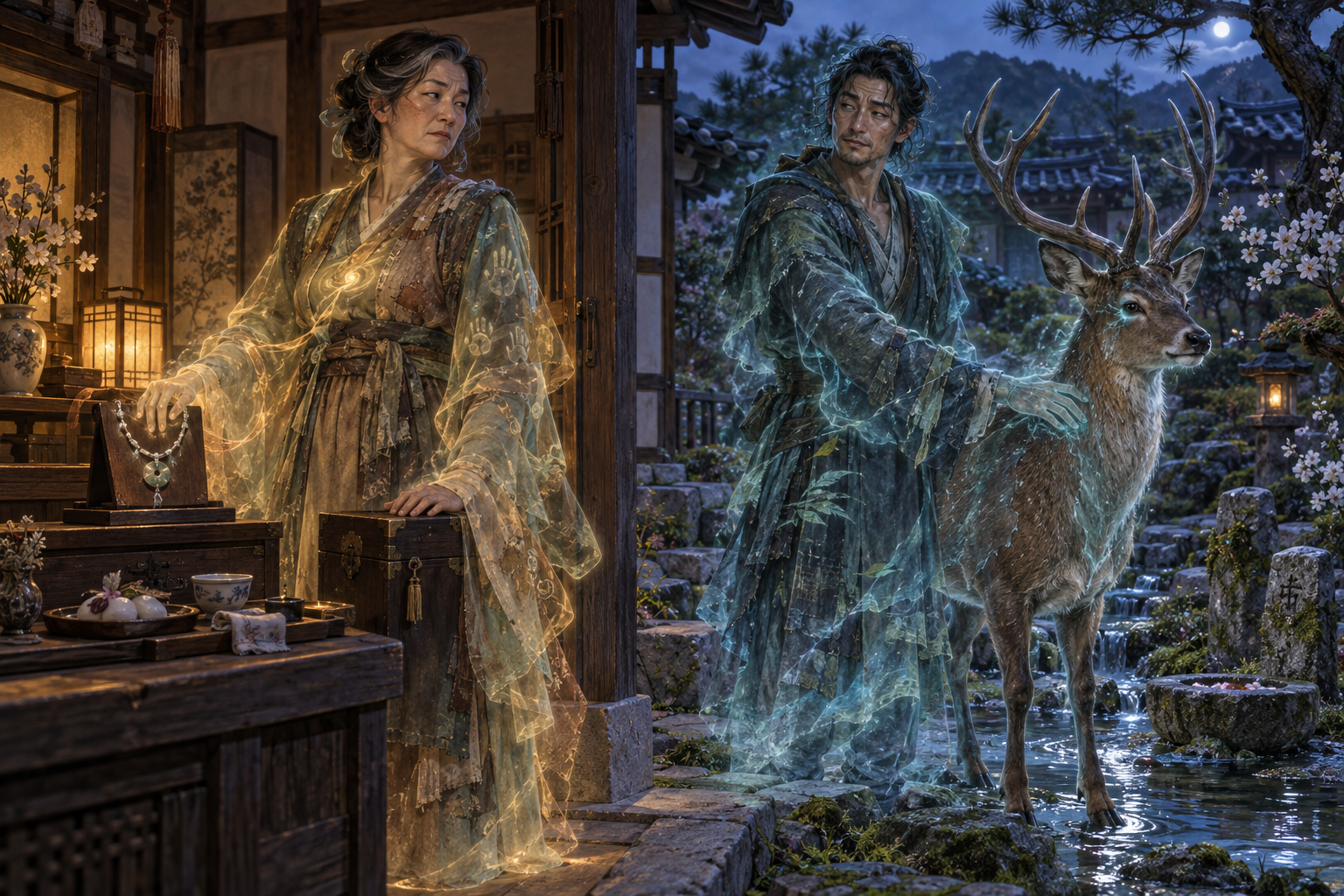
Spirits form when place, memory, repetition, emotion, death, or concentrated living breath gathers around a stable identity. Some inhabit physical objects or animals. Others exist through voices, weather, reflections, scents, dreams, or recurring patterns of event. Being old does not automatically make a spirit wise. Sometimes it simply gives a bad habit several centuries of confidence.
How Spirits Form
Repeated attention and accumulated living breath can give identity to a place or pattern. A bridge crossed for generations may develop a guardian. A household kitchen may remember the families that fed one another there. A battlefield may retain fear long after the soldiers are gone.
Form Is Flexible
A spirit does not require a humanlike body. It may inhabit an object, animal, structure, pool, grove, road, or other physical place. Some manifest only as sound, scent, weather, reflection, dreams, or repeating events. Identity matters more than anatomy.
Compacts
Seoul usually deals with spirits through negotiated compacts. These agreements define what a spirit receives, what humans receive in return, and what neither side is permitted to do. Temples often serve as mediators when a compact must be established, amended, or repaired.
What a Spirit May Ask
Food or seasonal offerings
Music, names, or ritual attention
Repairs to the place that formed it
Privacy or restricted access
Protected land or water
Personhood
Spirits maintaining a stable body, identity, and residence may petition for legal personhood. Recognition allows them to participate more directly in contracts, households, and civic life, but not every spirit wants to be incorporated into a human legal system.
Sovereignty Instead
Many spirits prefer negotiated authority over the place that formed them. A river spirit may hold standing over water use without becoming a citizen. A bridge guardian may demand maintenance and respectful crossing without caring who wins the next district election.
Spirits Are Not Automatically Benevolent
A spirit may be kind, territorial, irritating, protective, deceptive, frightened, generous, vindictive, or simply very particular about how people use its space. Spiritual age is not moral authority, and Seoul does not assume supernatural beings are truthful merely because they have been present longer than everyone else.
Killing the Problem Is Usually a Bad Plan
Destroying a spirit is difficult and may damage the place, object, ecosystem, or pattern that formed it. Seoul therefore favors boundaries, bargains, relocation, and repaired compacts whenever possible. A troublesome bridge guardian is still attached to a bridge everyone would prefer remained standing.
Mixed Households
A Seoul household might include humans, demi-humans, awakened beasts, adopted foreigners, and a resident spirit under entirely different legal relationships. A kitchen spirit can protect the household without belonging to it in the same way a husband, child, apprentice, or awakened animal does. Naturally, this does not stop anyone from arguing with it.
Faith of Seoul
The Three Lights
One sky, three divine paths
Seoul worships the Sun and twin Moons as three deities sharing one sky without sharing one nature. The faith does not teach that one light is superior. It teaches that society fails whenever one tries to perform the work of all three.
The Sun
The Sun governs life, strength, action, labor, courage, appetite, protection, and the visible consequences of choice. Sun paths begin with doing and deepen understanding through practice. In doctrine, action without reflection eventually becomes destruction.
The First Moon
The First Moon governs knowledge, guidance, memory, pattern, law, and reflection. Its paths begin with study, observation, and understanding before moving toward application. The faith warns that knowledge without compassion becomes cruelty.
The Second Moon
The Second Moon governs compassion, balance, adaptation, mercy, art, and change. Its teachings emphasize relationship, redirection, and the willingness to become different when circumstances demand it. Compassion without action, however, becomes permission for suffering to continue.
Birth Alignment
A child's first independent breath determines the initial record. Day births are Sun-born. Night births are Moon-born. Dawn, dusk, eclipse, and severe weather require a reflection rite using Star Lake water and the first clear celestial image witnessed by the attendants.
Recasting of Light
When sustained ability contradicts a person's registered path, a temple may authorize Recasting. After supervised work and outside testimony, the old birth seal is washed away at twilight and the new alignment entered into school, guild, examination, and inheritance records. Those who complete the rite are called Twice-Lit.
Daily Worship
Most homes keep a simple three-cup shelf. Water is offered to the First Moon, tea or milk to the Second Moon, and part of the first cooked food to the Sun. Morning prayer concerns work, evening prayer asks what was learned, and the final household prayer asks what must change tomorrow.
Useful Temples
Temples function as schools, registries, kitchens, mediation halls, animal refuges, and emergency shelters. Clergy are expected to be practically useful. Someone who knows every hymn but cannot organize a flood kitchen is regarded as spiritually decorative.
Death and Return
The dead are washed at sunset and kept beneath three lamps. The Sun receives their deeds, the First Moon their memories, and the Second Moon loosens what must change. Seoul teaches that a life is separated into what must be remembered, what must be answered for, and what must be released before the spirit can take another form.
Twice-Lit
Doctrine treats Recasting as correction of a mortal recording error rather than rebellion against the gods. Society is less tidy. Some families celebrate. Others resist lost plans, expense, embarrassment, or status changes. Temples regard attempts to force Recasting for prestige as religious fraud.
Restricted Historical Record
Seoul's religion began with three dragon demi-humans who protected the kingdom from the Others beneath the authority of successive Queens: one gold, one silver, and one white. History no longer remembers the connection. The dragons do.
Chapter Three
Power
Crown, district, oath, and temple beneath one sky.
Seoul is ruled through overlapping forms of authority. The Queen holds the crown, the Five Matrons govern the outer points, the Three Standards command through royal military oath, and the Temple Voices shape alignment, ritual, memory, and public legitimacy. None of them rule alone, and all of them occasionally wish the others would stop having opinions.
Royal House Five Matrons Three Standards Temple Voices
Seoul is a hereditary matriarchal monarchy, but the Crown shares the kingdom with powerful districts, religious institutions, examination offices, martial schools, and military authorities. The Queen sits at the center. The rest of Seoul has spent centuries making sure the center still has to listen.
The Crown of the Center
The Queen must descend through a recognized female line of the royal house, but succession does not automatically pass to the eldest daughter. Eligible daughters, sisters, nieces, and maternal cousins may enter the Lantern List. Candidates must serve in at least three districts, pass public examinations, demonstrate competence across Sun and Moon civic disciplines, and survive a year of public scrutiny before confirmation.
Court of Day Defense, roads, public works, disaster response, agriculture, trade enforcement, and urgent decrees.
Court of Reflection Records, taxation, examinations, law, archives, census, and long-term planning.
Court of Turning Appeals, welfare, Recasting, adoption, diplomacy, spirit compacts, interdistrict disputes, and exceptions.
A Queen Is Confirmed
The reigning Queen nominates her successor, but the Five Matrons and Three Lights Council must confirm the choice. Royal blood creates eligibility. It does not remove the examination process.
Matrons Have Terms
District Matrons may serve two seven-year terms. Removal requires either district recall or a joint finding by the Crown and national court.
Office Through Examination
Lower civil offices are open across genders through examination or guild appointment. Senior national ministries remain held by women because the seal creating national law must pass through a female officeholder.
Sects Still Answer to Law
Martial and cultivation schools may govern internal teaching and rank, but advanced practitioners must be registered, lethal techniques reported, and public rescue obligations honored. A prestigious secret manual remains a poor legal defense for an explosion.
Seoul's government works because power is distributed widely enough that no institution can comfortably pretend the others are decorative. The arrangement is stable, argumentative, and very effective at ensuring that every national emergency arrives with at least six qualified opinions.
Crown Archive
The Royal House
Seoul's royal household is both family and government. Affection is real, privacy is theoretical, and apparently even breakfast can acquire constitutional implications.
Queen of Seoul
Sovereign • Queenslands
Seo Hae-jin
Age 43 • Born Under the Sun • Recast Under the Moon
Hae-jin was raised for martial command before exposing a supply conspiracy during border service by recognizing patterns her advisers had missed. Her Recasting embarrassed the royal house and made her unusually popular among Twice-Lit citizens.
As Queen, she is disciplined, dryly funny, difficult to flatter, and intensely focused on keeping all five Starways open. She has two husbands and deliberately refuses to name either one senior consort.
Current Pressure
Hae-jin privately fears that the Star Lake's present disturbances may trace back to a flood-control project she authorized.
Royal Consort
Chief Legal Reader
Han Min-jae
Age 45 • Moon-Born • First Moon Cultivator
Min-jae is Hae-jin's longest-standing husband and chief legal reader. He possesses no sovereign seal, but his annotations strongly influence which arguments reach the Queen intact. His composure is frequently mistaken for obedience.
He maintains a season-bond with a Westpoint playwright who converts palace scandals into comedies with suspicious speed. His marriage to Hae-jin and that season-bond are separate relationships under Seoul law.
Current Pressure
Min-jae advocates stronger property protections for husbands, drawing criticism from conservative matrons who consider the proposal a threat to established household law.
Royal Consort
Palace Animal Master
Park Do-yun
Age 37 • Sun-Born • Southpoint
Do-yun entered the royal household after calming an entire panicked menagerie during an assassination attempt. He now manages palace animals, public ceremonies, and the Queen's travel stables.
Courtiers often underestimate him as charming decoration until they discover he remembers every guard animal, servant route, delivery schedule, and unfamiliar scent moving through the palace.
Household Note
Do-yun and Min-jae are affectionate but not romantically involved. Both men are married to Hae-jin, not to one another. Palace gossip remains tragically committed to misunderstanding the assignment.
Lantern List Candidate
Royal Niece • Succession Candidate
Seo Ji-won
Age 19 • Registered Moon-Born
Ji-won is the Queen's niece and a candidate for the Lantern List. She was educated for law beneath a Moon alignment, but her instincts consistently favor direct action, animal handling, and protective combat.
She wants to undergo Recasting beneath the Sun and understands perfectly well that a royal succession candidate publicly correcting her alignment will not remain a private religious matter.
Current Pressure
The royal house fears a second Twice-Lit ruler could be read as divine favor, proof of institutional failure, or both. Ji-won is angry enough to proceed anyway.
Star Council
The Five Matrons
Each outer point governs itself through a district Matron. Their authority is local, substantial, and intentionally difficult for the Crown to ignore.
Northpoint
Age 56 • Sun-Born
Baek Seol-in
Climber • Engineer • Former Azure Crane Master
Austere in public and considerably softer with children, Seol-in governs the springs feeding much of the Star Lake. She makes certain the Star Council remembers exactly where that water comes from.
Pressure: She believes the Crown is draining Northpoint's forests and water to beautify the Queenslands.
A-reum built her fortune through shipping insurance, salvage, and knowing which storms would close which ports. She cultivates a reputation for cheerful corruption while maintaining irritatingly immaculate legal records.
Pressure: Forged hearthstones are moving through her harbor, and somebody managed it without asking her permission.
Na-ri speaks softly, dresses plainly, and can estimate national grain reserves from a glance at three markets. Her sprawling household contains enough relatives and political opinions to qualify as a secondary government.
Pressure: She supports awakened-beast citizenship but opposes wild territory that would displace productive farms.
Yeon-hwa funds hospitals and scholarships while quietly binding recipients into durable networks of obligation. Her critics call this manipulation. She prefers the term organization.
Pressure: She suspects elite academy cultivation waste is connected to the rise in animal awakening and is withholding the theory until she can prove it.
Hye-su rose after her predecessor died during a breach. She sleeps in short shifts, carries seal chalk in every sleeve, and has limited patience for officials demanding perfect evidence from a safe distance.
Pressure: She believes something beyond the eastern border is driving animals toward the Star Lake. Her scouts are returning with missing memories.
Gold, Silver, and White are ancient dragon demi-human Crown Marshals who have served Seoul across generations of Queens. They hold no civil vote, receive no worship, and command only through the sovereign seal.
Gold Standard
Field Armies • Fortification • Heavy Response
Gwon Tae-gyeom
Exact Age Unknown • Appears 49 • Gold Dragon Demi-Human
Tae-gyeom commands Seoul's field armies and controls the moment when retreat becomes counterattack. Broad, heavily scarred, and unmistakably built for open battle, he bears gold scales, swept horns, folded wings, and a powerful tail. One horn was broken during a breach six Queens ago and grew back crooked.
He is direct, sociable, ravenous after deployment, and unnervingly calm once battle begins. His cultivation can reinforce bodies, weapons, and defensive lines with solar heat.
Fault Line
Tae-gyeom's oldest flaw is believing survival can justify decisions other people should have been allowed to make for themselves.
Private Record
He has kept lovers and several public season-bonds but never married. Too many prospective households courted the Gold Standard rather than asking what Tae-gyeom wanted when nobody needed saving.
Silver Standard
Strategy • Intelligence • Scouts • Logistics
Nam Seon-woo
Exact Age Unknown • Appears 44 • Silver Dragon Demi-Human
Seon-woo commands strategy, scouts, intelligence, military logistics, and seal formations. He remembers campaigns erased from every surviving archive and can identify an approaching formation by watching how animals abandon a road.
Dry, private, and extraordinarily patient, he is perfectly willing to let someone finish being wrong before correcting them. His cultivation preserves patterns and battlefield memory.
Current Pressure
The missing memories among Eastpoint scouts frighten him. An enemy capable of altering memory is attacking the very instrument he trusts most.
Private Record
Former lovers have included officers, archivists, artists, and one smuggler everyone politely calls a cartographer. He nearly married once before discovering the household expected access to royal intelligence through him.
White Standard
Evacuation • Medicine • Quarantine • Extraction
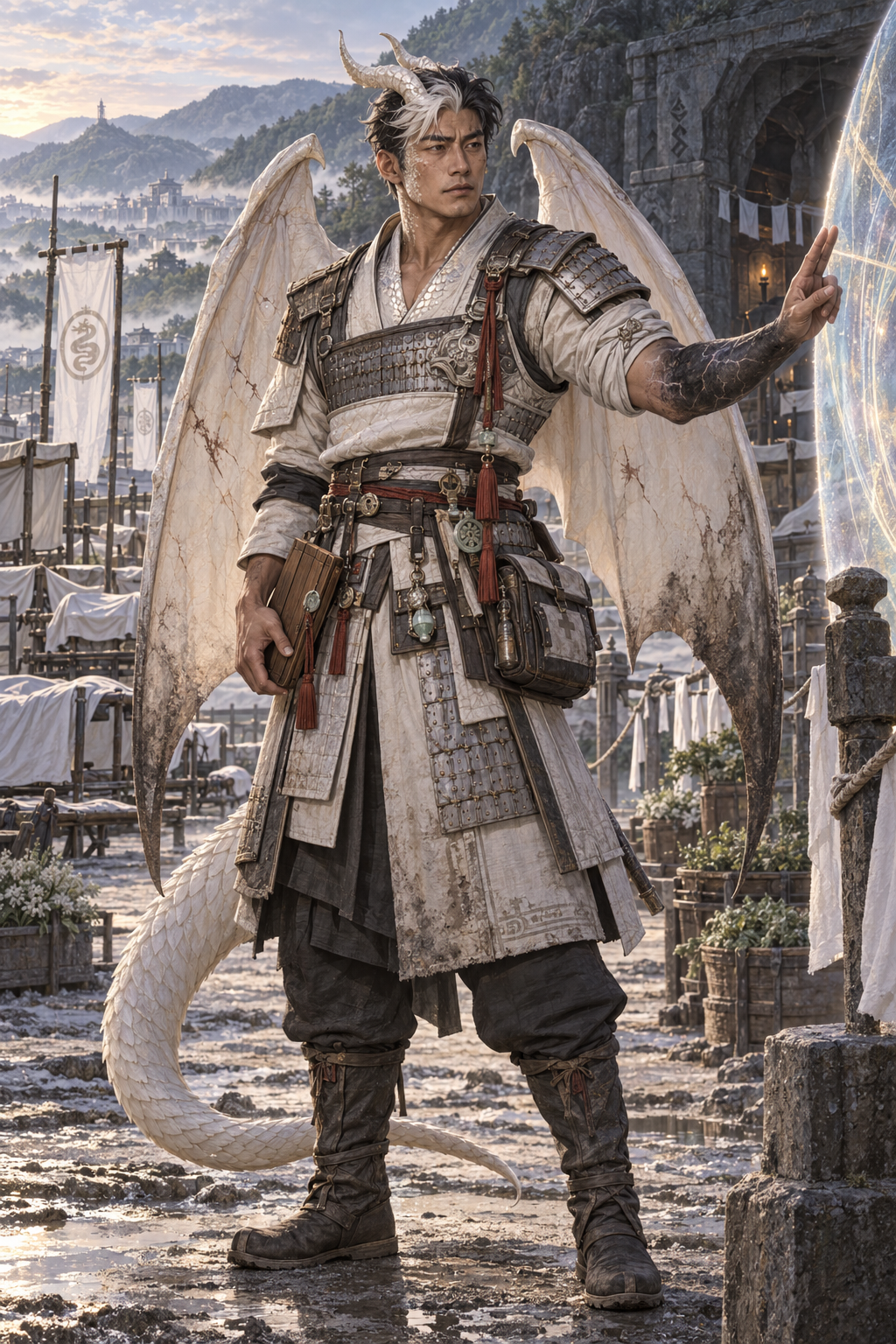
Ryu Hae-on
Exact Age Unknown • Appears 39 • White Dragon Demi-Human
Hae-on commands evacuation, military medicine, quarantine, spirit negotiation, counter-corruption, and rear-guard extraction. He decides what can still be saved and makes certain Seoul remembers that victory without survivors is administrative nonsense.
Warm, irreverent, and observant, Hae-on becomes ruthlessly decisive when delay will spread suffering. He can redirect damaged living breath and stabilize corrupted bodies. One forearm remains permanently darkened by old contamination.
Cost of Cultivation
When he works too long, Hae-on absorbs emotional and instinctive residue from the people he treats.
Private Record
He has had passionate affairs, quiet season-bonds, and relationships lasting longer than some dynasties. Too many partners loved him while healing and left once their lives became ordinary. He wants to be chosen when there is no crisis to solve.
Silver Finds the Pattern Seon-woo handles strategy, intelligence, memory, positioning, logistics, and what the enemy is actually doing.
White Preserves Hae-on handles survival, evacuation, healing, quarantine, extraction, and what must be brought home.
Sealed Historical Record
The Queen determines which Standard leads each campaign. Tae-gyeom acts. Seon-woo determines the pattern. Hae-on preserves what must survive. Centuries later, Seoul's theology would describe the Sun, First Moon, and Second Moon in almost exactly the same terms. This is not a coincidence. The three dragons remember how the religion began. They have politely declined to correct the clergy.
National Clergy
Temple Voices
Seoul's temples do far more than conduct worship. They operate schools, registries, mediation halls, kitchens, animal refuges, emergency shelters, and the rites that determine or correct a citizen's alignment. Their senior voices therefore possess religious authority with very practical consequences.
High Lamplighter
National Solar Clergy
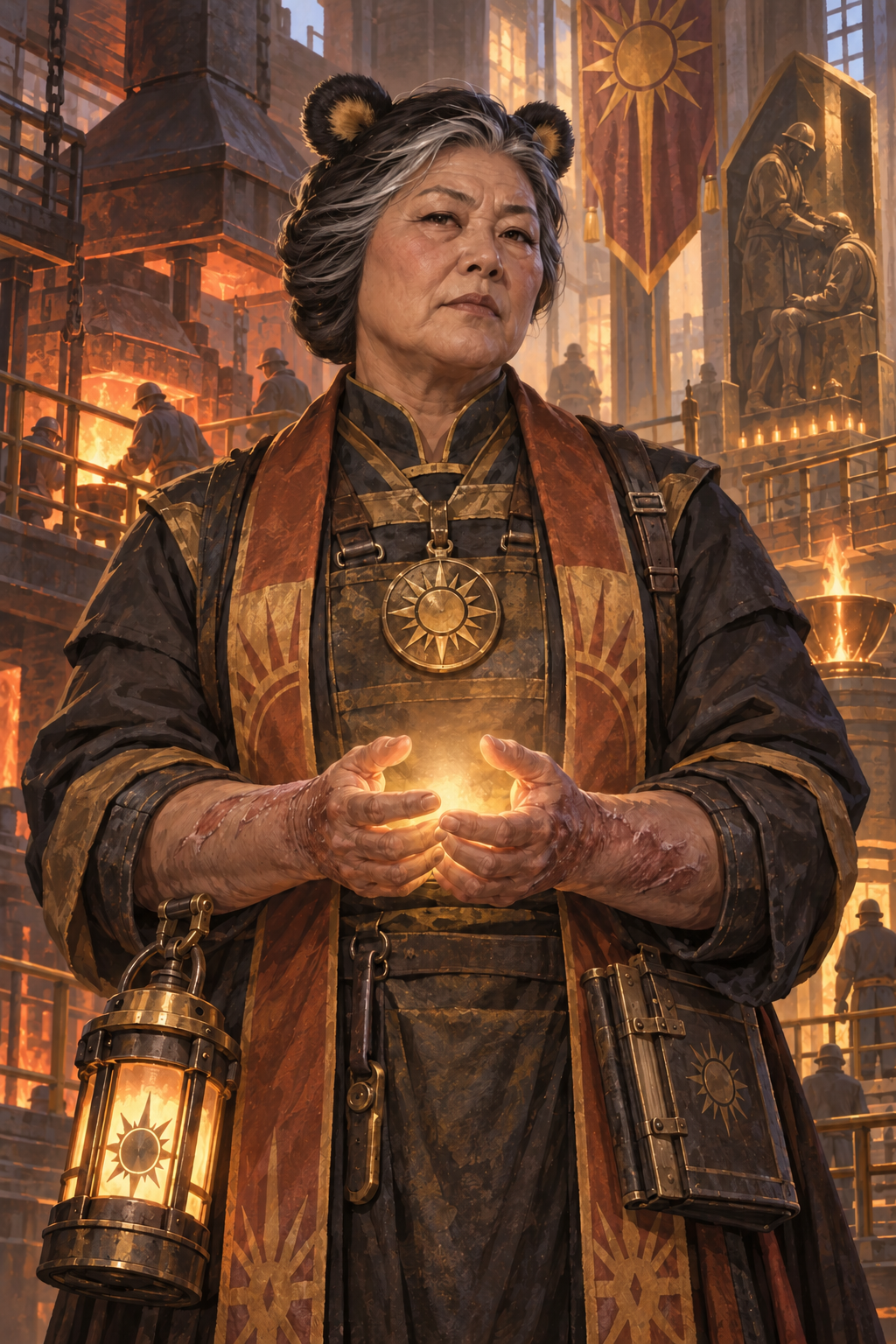
Im So-ra
Age 65 • Sun-Born
So-ra began her working life in a foundry and still carries burn scars across both hands. She rose through the solar clergy without losing the habits of someone who believes sacred principles should remain useful when the furnaces are hot and somebody is bleeding.
She treats labor safety as religious law and is notorious for publicly humiliating guild masters who endanger workers. Her cultivation allows her to warm a failing heart through touch.
Current Pressure
So-ra opposes palace proposals to ration hearthstones according to household rank. Her popularity among workers makes the government careful around her and gives her enemies excellent reasons to manufacture scandal.
White Mirror
Senior Voice of the Twin Moon Temples
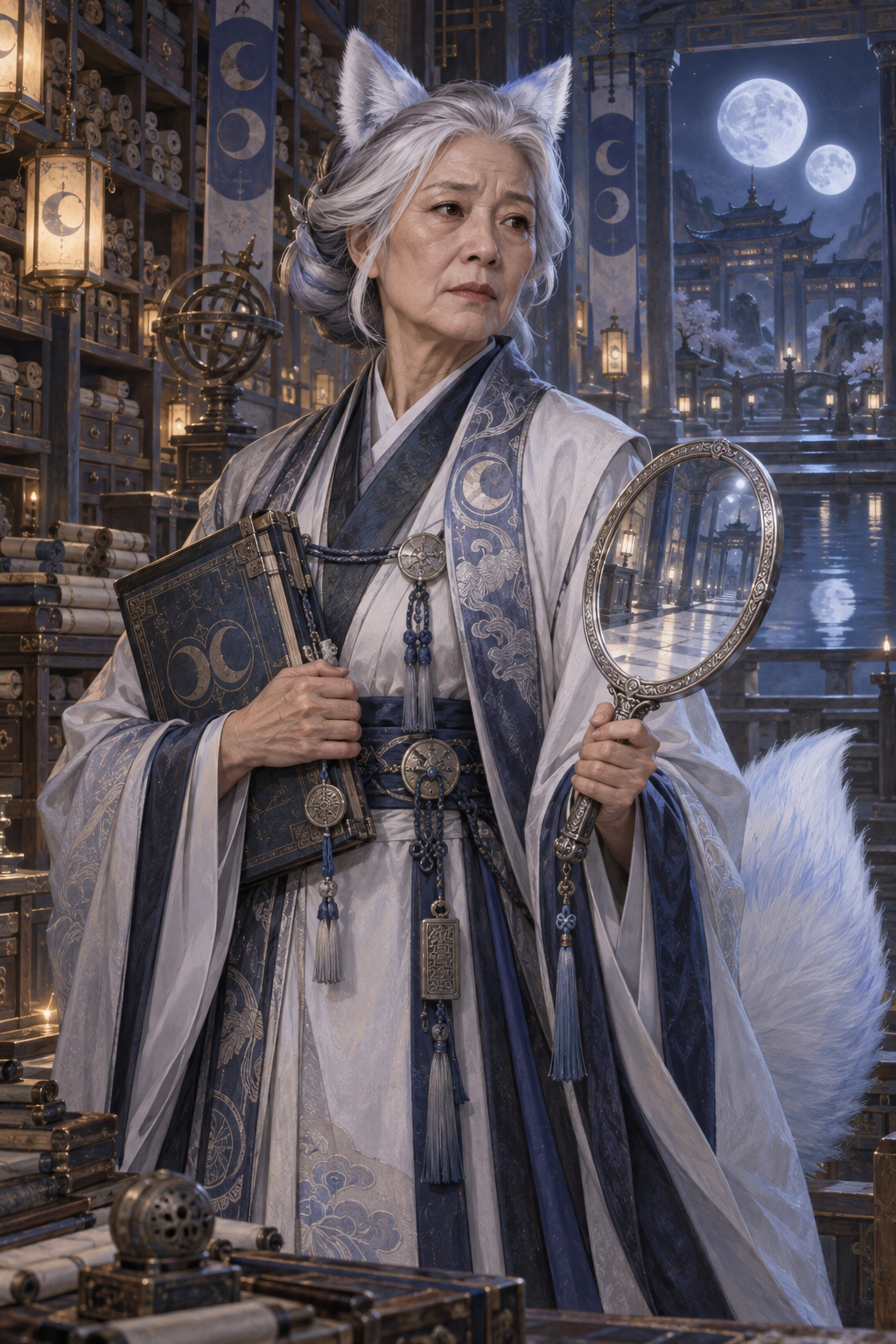
Yun Mi-ra
Age 70 • Moon-Born
Mi-ra is an archivist, mediator, and master of memory forms capable of reciting legal precedents older than many of Seoul's surviving buildings. Her authority reaches wherever religion, memory, law, and personal identity overlap.
She helped standardize the Recasting process so children placed beneath the wrong Light could correct their records without being treated as failures or curiosities.
Current Pressure
Mi-ra suspects ambitious families are coaching candidates into fashionable Twice-Lit status rather than allowing Recasting to reflect genuine ability.
Private Record
Her own memories have begun repeating events that never happened, an early sign of First Moon strain that she has told no one.
The Sun Acts Solar clergy emphasize labor, protection, physical duty, courage, practical service, and the consequences of action.
The Moons Reflect Moon clergy oversee memory, law, guidance, mediation, compassion, adaptation, and the interpretation of change.
All Three Correct Recasting requires mixed clergy because no single Light is permitted to decide that another has recorded a life incorrectly.
Seoul expects clergy to be useful. Temples teach children, preserve records, feed neighborhoods, mediate disputes, shelter animals, and coordinate emergency relief. A priest who knows every hymn but cannot organize a flood kitchen is considered spiritually decorative.
Chapter Four
People
The kingdom is more than the offices that govern it.
Beyond Queens, Matrons, clergy, and Crown Marshals are the people who keep Seoul moving from one ordinary crisis to the next. Investigators follow forged records. Pilots move through dangerous water. Healers work where human, animal, and magical lives overlap. Wardens watch the borders, and awakened citizens build lives that old law never expected to accommodate.
The people gathered here are not Seoul's highest authorities. They are investigators, pilots, physicians, rescuers, wardens, and awakened citizens whose work places them directly against the kingdom's changing edges. Several are already carrying pieces of the same problem without knowing it.
Missing hearthstones, forged recognition papers, impossible memories, migrating animals, heatless burns, sealed cargo, missing patrol hours, and disturbances in the Star Lake appear in different professions and districts. None of these people possesses the whole pattern. Together, they are beginning to outline it.
Westpoint A sealed crate knocked back when it heard water.
Moonpoint Unrelated patients remember the same nonexistent house.
Eastpoint A veteran tracker returned missing nine hours.
Above the Lake Garam saw the water open like an eye.
Case Files
Law & Trade
Seoul's trade network moves through ledgers, seals, roads, harbors, and people who know how to read all of them. Right now, the paperwork is lying and at least one piece of cargo has begun answering back.
Office of Warmth
Cross-District Investigator
Jang Tae-ho
Age 32 • Moon-Born
Tae-ho investigates counterfeit hearthstones, forged seals, and trade crimes that cross district boundaries. He is meticulous enough to follow a false document through layers of respectable bureaucracy and socially flexible enough to enter households where men are likely to be underestimated.
He is flirtatious when nervous, which occasionally makes witnesses think he is considerably less focused than he actually is.
Current Case
His investigation links missing hearthstone shipments, false animal-recognition papers, and a Queenslands ministry account that officially does not exist.
Deep-Channel Pilot
Westpoint Waterways
Choi I-seul
Age 29 • Moon-Born • River-Otter Demi-Human
I-seul is one of Westpoint's youngest licensed deep-channel pilots. Compact, quick, and shamelessly social, he can read a current from something as small as the movement of trash against a piling.
He flirts easily but takes promises seriously, a distinction other people repeatedly fail to understand. He is unmarried and keeps no active season-bond. What he actually wants is a household capable of recognizing that playfulness and unreliability are not the same thing.
Three Nights Ago
I-seul ferried a sealed cargo through Westpoint. Something inside the crate knocked back when it heard water.
Paper and Water
Tae-ho is following irregularities through Seoul's records while I-seul has encountered something suspicious moving through its physical trade routes. Whether his sealed cargo belongs to Tae-ho's investigation is not yet established. For now, they represent two different edges of the same increasingly unreliable system.
Field Records
Care & Defense
Seoul's healers, rescuers, and wardens are often the first to notice when ordinary problems stop behaving normally. Animals are changing, memories are failing, and wounds are appearing without the causes that should have produced them.
Veterinarian
Hundred Hooves House
Park Geon-u
Age 40 • Sun-Born • Ox Demi-Human
Geon-u is a veterinarian and senior instructor at the Hundred Hooves House. Enormous, soft-spoken, and patient with pain, he becomes considerably less gentle when the problem was caused by preventable stupidity.
He can set a horse's leg, wrestle a panicked bull away from a child, and cook enough soup for forty people without measuring anything.
Current Problem
A group of newly awakened cattle has asked Geon-u to hide them from the royal census.
Household Pressure
Geon-u has never married. His mother's clinic depends on him, while marriage would normally move him into a wife's household. Every serious courtship eventually becomes an argument about where duty lives.
Light-Strain Specialist
Moonpoint Medicine
Yun Seong-ho
Age 31 • Siberian Tiger Demi-Human • Sun-Born, Recast Moon
Seong-ho specializes in light-strain, treating cultivators whose magic has begun damaging their bodies, memories, or sense of self.
Precise, blunt, and difficult to embarrass, he is secretly delighted by terrible street theater. His own Recasting left him deeply suspicious of anyone claiming to understand another person after a single conversation.
Current Problem
Several unrelated patients have described the same childhood memory, including details from a house that never existed.
Private Life
Seong-ho is unmarried and has no current season-bond, mostly because he treats courtship like an uncontrolled medical variable.
Mountain Rescue Captain
Northpoint • Azure Crane Hall
Baek Jun-seo
Age 35 • Sun-Born • Goral Demi-Human
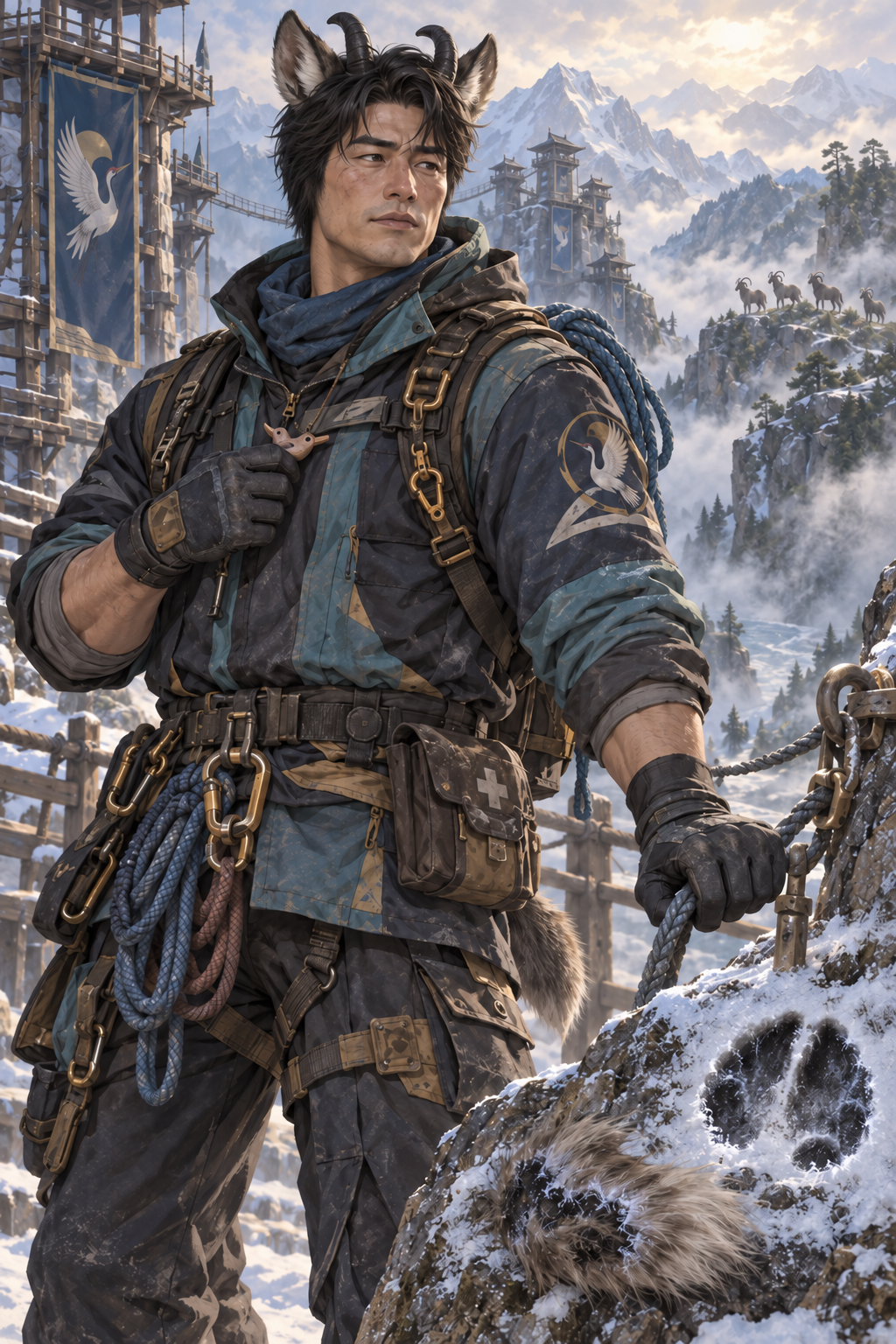
Jun-seo commands a Northpoint mountain rescue company attached to Azure Crane Hall. Broad-built and steady-handed, he is nearly impossible to rattle while hanging from a cliff. Formal dinners are another matter entirely.
He carves small bird whistles for frightened children and insists they are practical signaling equipment.
Latest Patrol
His rescue company found migrating animals marked by burns that produced no heat.
Household Pressure
Jun-seo has rejected several marriage negotiations because each household expected him to abandon rescue work after joining them.
Jade Gate Warden
Eastpoint Senior Tracker
Kang Mu-yeol
Age 38 • Sun-Born • Korean Magpie Demi-Human
Mu-yeol looks severe until he speaks, at which point he proves warm, practical, and annoyingly fond of singing to anxious patrol animals. He grows medicinal herbs outside every barracks where he serves and can make excellent dumplings under battlefield conditions.
As a senior Jade Gate tracker, scent and environmental memory are part of how he reconstructs movement through dangerous territory.
Latest Patrol
Mu-yeol returned missing nine hours and cannot smell where he went.
Household Pressure
Powerful houses repeatedly approach him as though marrying a decorated warden would add a weapon to their estate. He keeps refusing women who discuss his rank before asking what he wants.
Awakening Newly awakened cattle are frightened enough of official recognition to ask a veterinarian to conceal them.
Memory Moonpoint patients share memories they should not possess.
Migration Northpoint animals are moving with impossible, heatless burns.
Eastpoint One of Seoul's experienced trackers has lost nine hours and even his own senses cannot reconstruct them.
Four Different Symptoms
Geon-u, Seong-ho, Jun-seo, and Mu-yeol are not investigating a shared case. Each is responding to a different problem in a different district. What makes the pattern disturbing is that animals, memory, cultivation, and the border are all beginning to fail in ways Seoul's existing systems do not explain.
Wild Records
Wild & Winged
Seoul's laws increasingly recognize that citizenship, personhood, and belonging do not require a human body. Garam and Grandmother Moss occupy two very different places within that expanding idea of who counts as someone.
Crown Courier
Awakened Red-Crowned Crane
Garam of the Reed Crown
Exact Age Unknown • Legally Recognized 12 Years
Garam is an awakened male red-crowned crane who carries sealed messages between Seoul's districts. He travels both in crane form and in a tall humanlike form that retains his red crown, feathering instead of hair, and wings.
Elegant in flight and blunt in conversation, Garam is territorial about rooftops and fascinated by human gift customs. His occupation gives him an unusual view of Seoul: roads, waterways, district borders, and the Star Lake all look very different from above.
Legal Status Recognized awakened citizen.
Forms Crane and tall humanlike form.
Above the Star Lake
Garam saw the water at the Missing Point open like an eye. Something beneath it looked back.
Household Note
Garam is unmarried, unbonded, and has never taken a season-lover. He would consider joining a household only if nobody expected him to sleep indoors every night.
Territorial Person
Northpoint Hot Springs
Grandmother Moss
Age Uncertain • Official Classification: Awakened Black Bear
Grandmother Moss occupies a Northpoint hot spring under an ancient compact guaranteeing safe passage around her valley. She speaks slowly, remembers six Queens, dislikes armor, and accepts tribute in pears, carved combs, or useful gossip.
Seoul recognizes her as a territorial person rather than an ordinary citizen. Her compact protects her authority over the place she inhabits without requiring her to join a household or participate in human civic life.
Legal Status Territorial person under ancient compact.
Territory Northpoint hot spring and surrounding valley.
Current Change
Grandmother Moss has stopped hibernating and begun asking why the lake is breathing while asleep.
Outside the Usual View
Garam crosses the kingdom from above while Grandmother Moss has remained in one Northpoint valley across generations. One sees Seoul through movement. The other sees it through duration. Both have noticed something wrong with the Star Lake before most human institutions have agreed on what they are looking for.
Restricted Classification Record
Grandmother Moss is not actually an awakened bear. She is an ancient black-bear shifter who overwhelmingly prefers her bear form. Seoul classified her incorrectly centuries ago, and she has never considered the mistake important enough to correct. The kingdom has therefore spent generations using one of its oldest legal compacts as evidence for awakened-beast policy while the subject of that compact quietly knows the original paperwork is wrong.
Chapter Five
Threads Beneath the Lake
Nothing is proven. Too many things are rhyming.
Hearthstones disappear into false ledgers. Animals awaken faster than Seoul's laws can absorb them. Memories vanish, repeat, or belong to places that never existed. The Star Lake moves strangely beneath familiar shores. These disturbances may be connected. They may also be several different crises arriving at once. This record keeps the evidence separate until Seoul has earned the right to join the threads.
○ Observed Documented events, physical evidence, or direct witness accounts.
◇ Suspected Plausible connections that remain unproven or incomplete.
◆ Restricted Information unavailable to most citizens of Seoul.
Correlation is not confirmation. Known threats are not presumed culprits.
Active Investigations
Five Disturbances, One Pattern?
Every thread below is real. The connections between them are not. Not yet. Seoul has evidence of fraud, awakening, memory failures, unusual lake behavior, and known dangers beyond its borders. This board records what is known without turning suspicion into fact.
Shared Geography
The Star Lake Basin All five districts ultimately feed, border, trade through, defend, or depend upon the waters gathered at Seoul's center.
The board is allowed to be wrong. Its purpose is to preserve evidence, competing explanations, and unanswered questions until enough of Seoul's scattered information finally agrees.
Thread 01 • Trade Investigation
Forged Hearthstones
The paper trail begins with missing goods and false records. It reaches from government accounts to Westpoint's harbor, where something has been moving through Seoul under seals that may not mean what they claim.
Observed Fraud, missing shipments, and forged documentation.
Suspected Several incidents may belong to one trade network.
Unknown The identity and purpose of I-seul's cargo.
Investigator
Jang Tae-ho
Office of Warmth
Tae-ho's case links missing hearthstone shipments, counterfeit seals, false animal-recognition papers, and a Queenslands ministry account that officially does not exist.
Harbor Authority
Moon A-reum
Matron of Westpoint
Forged hearthstones are moving through A-reum's harbor. She knows Westpoint's shipping, salvage, insurance, and customs systems intimately enough that bypassing her attention is itself suspicious.
Witness
Choi I-seul
Deep-Channel Pilot
I-seul ferried sealed cargo through Westpoint. Something inside the crate knocked back after hearing water. He does not know what the cargo was.
Current Evidence Ledger
Observed
Hearthstone shipments are missing from legitimate trade records.
Observed
Forged seals and false animal-recognition papers appear inside Tae-ho's investigation.
Observed
A Queenslands ministry account connected to the case officially does not exist.
Observed
Forged hearthstones have entered Westpoint's trade routes.
Observed
I-seul transported sealed cargo containing something capable of reacting to nearby water.
Suspected
The forged documents, missing hearthstones, harbor traffic, and sealed cargo may represent different pieces of the same distribution network.
Unresolved
Nothing currently identifies the contents of I-seul's crate as an awakened beast, spirit, Other, or any other specific kind of being.
Working Theory
Someone appears to be using legitimate trade infrastructure, fraudulent documentation, and government-facing records to move goods or beings through Seoul without ordinary scrutiny. Whether there is one organization behind every irregularity remains unproven.
Thread 02 • Living Breath
Animal Awakening
Animals have always been capable of awakening in Seoul. What has changed is the rate. The Star Lake is producing more awakened animals than historical records predict, turning a spiritual curiosity into a legal, ecological, and civic problem.
Observed Animal awakening is occurring more often than historical records predict.
Suspected Cultivation waste or disturbed living breath may be involved.
Unknown Why the Star Lake's ecology has changed now.
Direct Witness
Park Geon-u
Veterinarian • Hundred Hooves House
Geon-u works where ordinary animal care and awakened personhood collide. A group of newly awakened cattle recently asked him to hide them from the royal census. Their fear makes the crisis more than a question of how many animals are waking up.
Land Pressure
Park Na-ri
Matron of Southpoint
Na-ri supports awakened-beast citizenship but opposes granting protected wild territory when doing so would displace productive farms. Her conflict is not whether awakened animals are people. It is what happens when recognizing new people requires existing land.
Working Theory
Jin Yeon-hwa
Matron of Moonpoint
Yeon-hwa suspects the rise in awakening may be connected to cultivation waste produced by elite academies. She has not released the theory publicly and is withholding it until she can prove both the mechanism and which patrons would be implicated.
Public Precedent
Grandmother Moss
Northpoint Territorial Person
Seoul's records classify Grandmother Moss as an awakened black bear whose ancient compact predates much of modern awakened-beast law. More recently, she has stopped hibernating and begun asking why the Star Lake is "breathing while asleep."
Current Evidence Ledger
Observed
The Star Lake is producing more awakened animals than historical records predict.
Observed
Newly awakened cattle have approached Geon-u for help avoiding the royal census.
Yeon-hwa believes cultivation waste from elite Moonpoint academies may contribute to the increase. The theory remains unproven.
Unresolved
It is not established whether rising awakening, unusual animal migration, and changes in the Star Lake's living-breath circulation share one cause.
Unresolved
Forced awakening is a serious magical crime in Seoul, but there is currently no evidence that the present surge is the result of deliberate forced awakening.
Temple View Some temples interpret the increase as a blessing: more living beings reaching stable reason and personhood.
Agricultural View Farms see animals becoming people with legal rights, food needs, families, and possible claims to the land they once occupied as livestock or wildlife.
Crown View The government sees a citizenship system approaching capacities it was never designed to handle.
Working Theory
Something has changed within the ecological and magical conditions surrounding the Star Lake. Increased awakening is documented. The mechanism is not. Cultivation waste, altered living-breath circulation, and broader lake disturbances remain competing or potentially overlapping explanations.
Restricted Classification Record
Grandmother Moss is not an awakened beast. She is an ancient black-bear shifter who overwhelmingly prefers bear form. Seoul classified her incorrectly centuries ago, and she has never felt obligated to correct the record. Her recent behavior may still matter to the changing Star Lake, but her existence cannot legitimately be counted as evidence of animal awakening.
Thread 03 • Memory Anomalies
Missing Memories
Eastpoint patrols are returning with holes in their memory. Moonpoint patients are remembering the same childhood events from a house that never existed. Seoul knows memories can fail. What it does not know is whether these failures belong to the same phenomenon.
Observed Multiple independent memory anomalies are documented.
Suspected Eastpoint and Moonpoint incidents may share a cause.
Unknown Whether memory is being erased, altered, copied, or replaced.
Command Record
Kang Hye-su
Matron of Eastpoint
Hye-su's scouts are returning from the eastern border with gaps in their memories. She already believes something beyond the border is driving animals toward the Star Lake, making the missing time impossible for her to dismiss as ordinary fatigue or confusion.
Direct Witness
Kang Mu-yeol
Senior Jade Gate Tracker
Mu-yeol returned from his latest patrol missing nine hours. As a tracker, he should be able to reconstruct movement through scent and environmental traces. He cannot smell where he went.
Strategic Review
Nam Seon-woo
Silver Standard
Seon-woo's cultivation preserves patterns and battlefield memory. He remembers campaigns erased from surviving archives. The Eastpoint gaps frighten him because memory is not merely personal to his work. It is one of Seoul's strategic instruments.
Current Evidence Ledger
Observed
Multiple Eastpoint scouts have returned from patrol with gaps in their memories.
Observed
Mu-yeol personally lost nine hours during a patrol and cannot reconstruct the missing route through scent.
Observed
Several unrelated Moonpoint patients have described the same childhood memory, including details of a house that appears never to have existed.
Suspected
The Eastpoint losses and Moonpoint shared memories may be different expressions of one disturbance involving memory.
Unresolved
Seoul cannot yet determine whether memory is being removed, overwritten, copied between people, fabricated, or distorted by unrelated causes.
Linked Medical Record
Doctor Yun Seong-ho
Seong-ho treats cultivators suffering light-strain in Moonpoint. Several unrelated patients under his care have reported the same impossible childhood memory, including architectural details from a house no record can locate.
Restricted Temple Record
White Mirror Yun Mi-ra
Mi-ra is a master of memory forms and one of Seoul's most experienced Moon authorities. Her own memories have begun repeating events that never happened. She currently believes this is early First Moon strain and has told no one.
Absence Eastpoint witnesses lose stretches of lived experience.
Addition Moonpoint patients possess memories of events they did not apparently live.
Repetition Mi-ra's own memory is replaying events that never occurred.
Working Theory
Seoul may not be dealing with simple memory loss. The evidence includes missing experience, shared impossible memories, and repeated false events. If these incidents share one cause, whatever is happening may affect the structure of memory rather than merely damaging recall.
Restricted Comparative Threat Record
Seoul's wider records include beings capable of affecting memory. Devouring Wraiths, an S-Class Other, are known to consume memory alongside sound, light, heat, magic, and life. This is comparative information only. No Devouring Wraith, or any other known Other, has been confirmed in connection with Seoul's current memory anomalies. Similarity of effect is not identification of cause.
Thread 04 • Star Lake
The Breathing Lake
Every watershed in Seoul eventually reaches the Star Lake. Its ecology also makes living breath unusually dense and responsive. If something changes at the center, the effects need not remain at the center.
Star Lake Basin
Observed Multiple witnesses have reported unusual behavior connected to the lake.
Suspected Changes in the lake may connect to wider disturbances in living breath and animal behavior.
Unknown What Garam saw beneath the Missing Point.
Aerial Witness
Garam of the Reed Crown
While flying above the Star Lake, Garam saw the water at the Missing Point open like an eye. Something beneath it looked back.
Long-Term Witness
Grandmother Moss
Grandmother Moss remembers six Queens and has remained in Northpoint long enough to recognize patterns most living officials cannot compare against. She has stopped hibernating and begun asking why the lake is "breathing while asleep."
Current Evidence Ledger
Observed
All five district watersheds ultimately meet within the Star Lake, making changes there capable of affecting systems throughout Seoul.
Observed
Living breath is unusually dense and responsive within the Star Lake's ecology.
Observed
Garam witnessed an unexplained opening in the water at the Missing Point and perceived something beneath the surface.
Observed
Grandmother Moss has altered her normal seasonal behavior and describes the lake as breathing while asleep.
Suspected
The increase in animal awakening, animal movement toward the basin, and other living-breath disturbances may reflect a change in the Star Lake itself.
Unresolved
Nothing currently identifies the presence beneath the Missing Point as a spirit, awakened being, Other, natural phenomenon, or any known category at all.
Water Five separate watersheds converge here, tying every district physically to the same basin.
Living Breath Seoul's unusually responsive magical ecology is concentrated around the lake.
Dependence Agriculture, transport, cultivation, settlement, and district politics all depend upon water moving through this system.
Working Theory
The Star Lake may be more than the place where Seoul's disturbances become visible. It may be the system through which some of them are spreading. That remains a theory. The kingdom has not established whether the lake is the cause, the victim, or simply the place where multiple problems are converging.
Restricted Royal Record
Queen Seo Hae-jin has a private concern she has not established as fact. She fears the Star Lake's current disturbances may have begun with a flood-control project she authorized. No causal connection has yet been proven. Her concern remains important because a project intended to stabilize Seoul's water system may have altered something the Crown did not fully understand.
Thread 05 • External Threat Archive
The Others
An Other is defined by origin through the rifts, not by species, culture, morality, or allegiance. Some hunt. Some guard. Some imitate. Some bargain, bond, or simply pass through the world according to rules of their own.
Threat Class Is Not Morality S through E measures the force normally required to survive or contain an encounter. It does not determine whether an Other is hostile.
S-ClassDragon-slaying • Civilization-ending
S
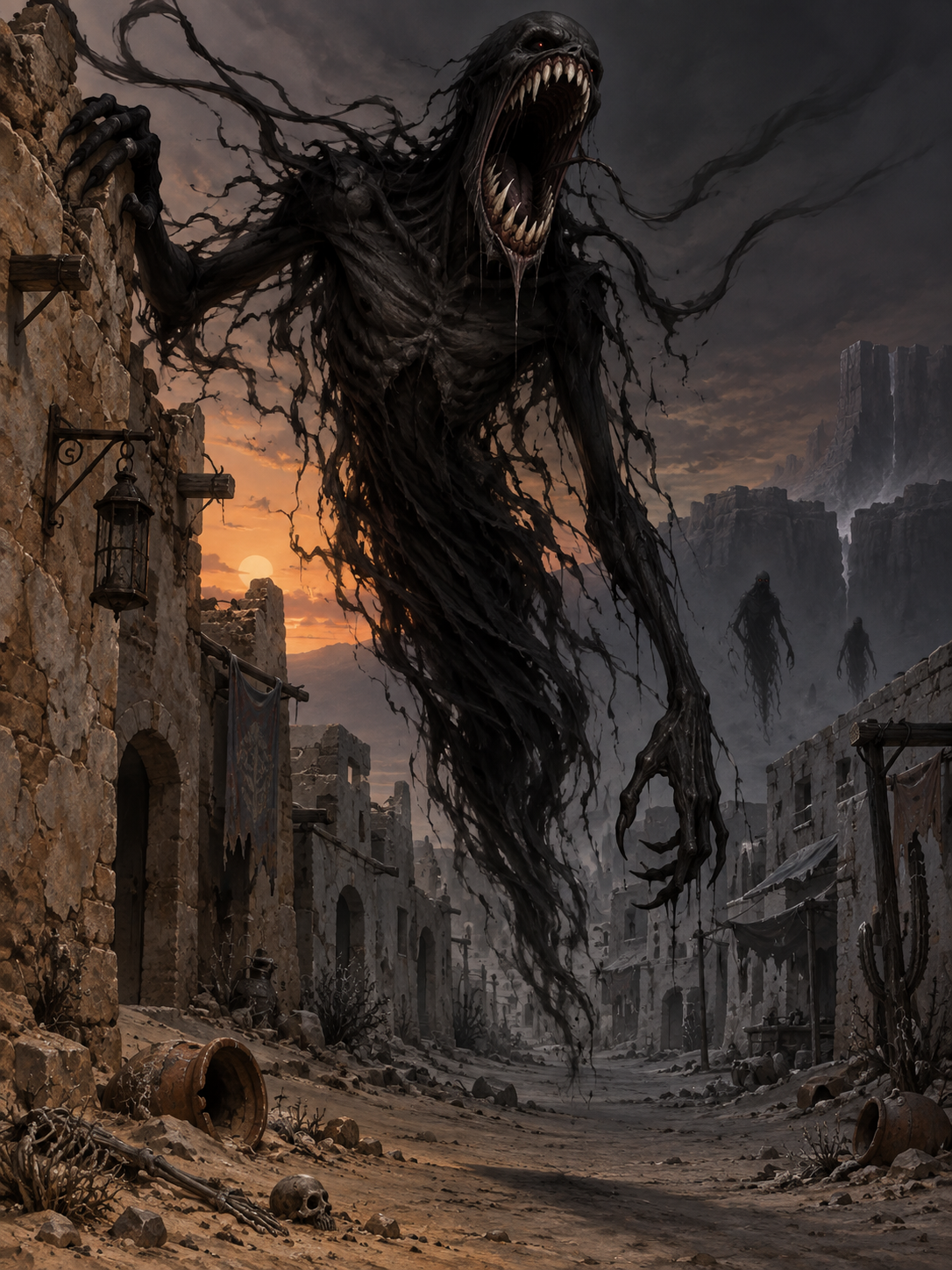
Devouring Wraiths
Almost-human shadow entities that consume sound, light, heat, magic, memory, and life.
S
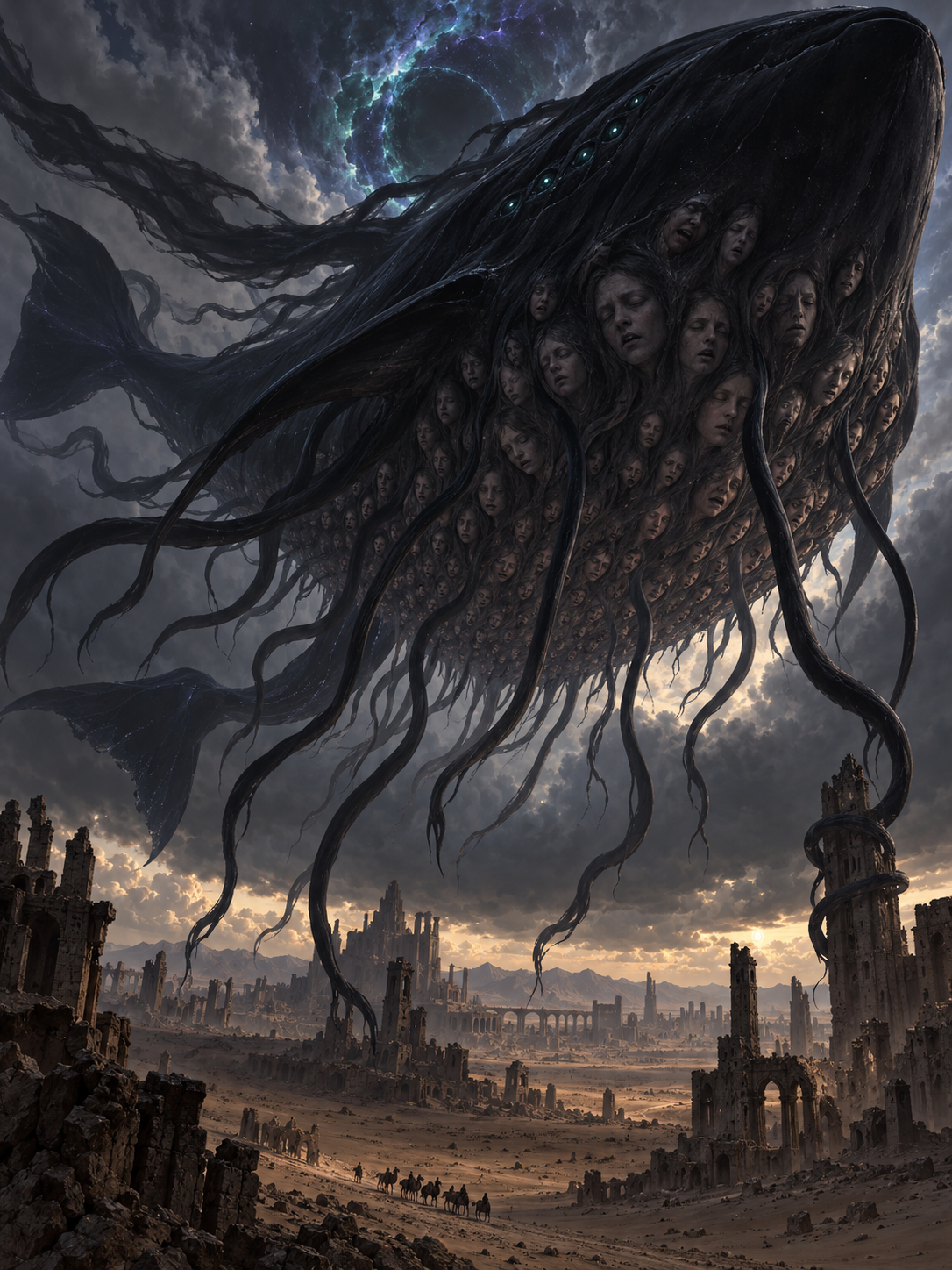
Leviathans
Colossal wingless black whales that swim through the sky, altering storms, pressure, earthquakes, and terrain.
A confirmed S-Class sighting is treated as a regional survival event, not an ordinary battle.
A-ClassExtreme • Coordinated resistance
A
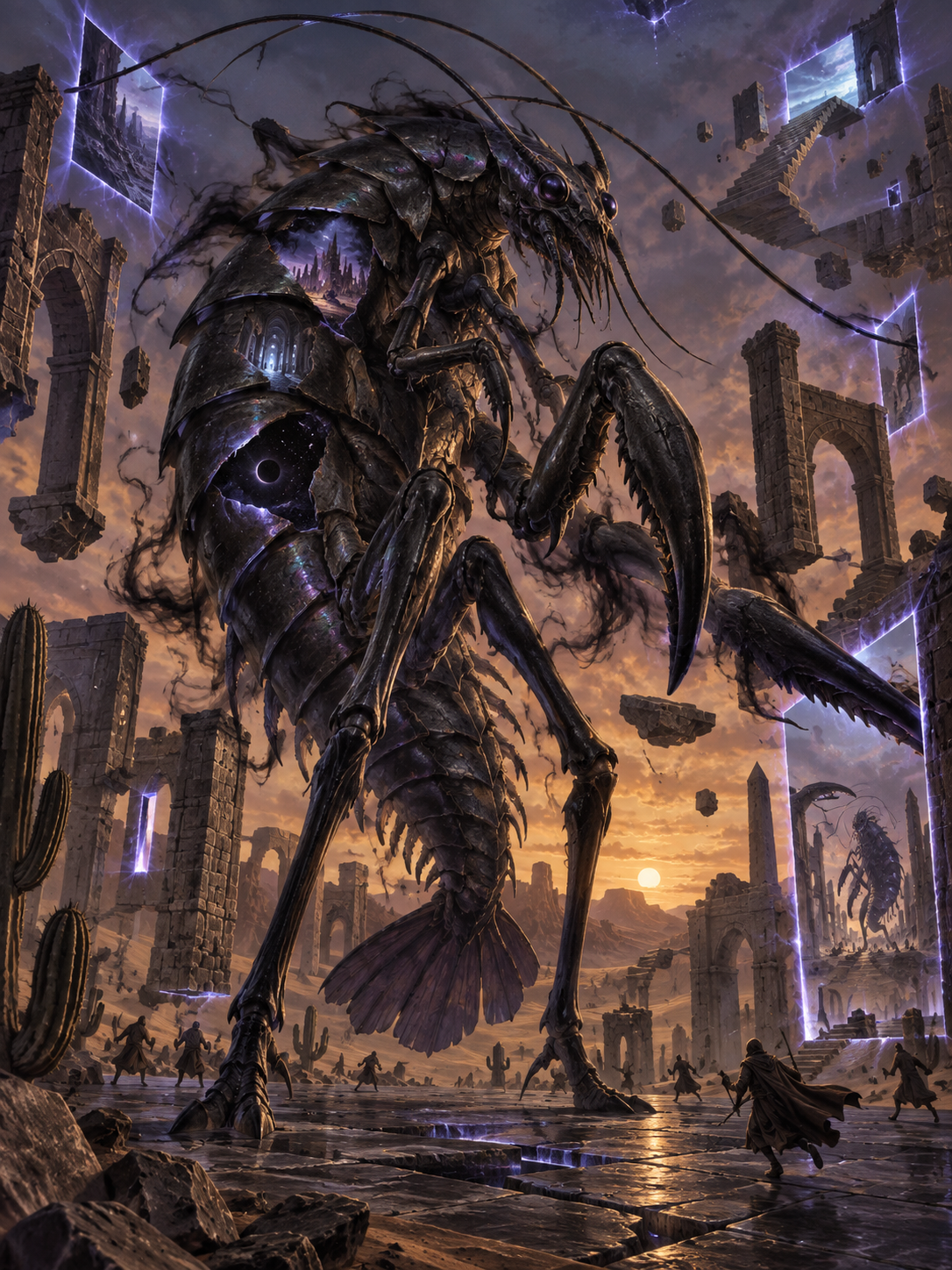
Harbingers of the Abyss
Insect-crustacean hybrids that fold distance, alter adjacency, and create rifts between locations.
A
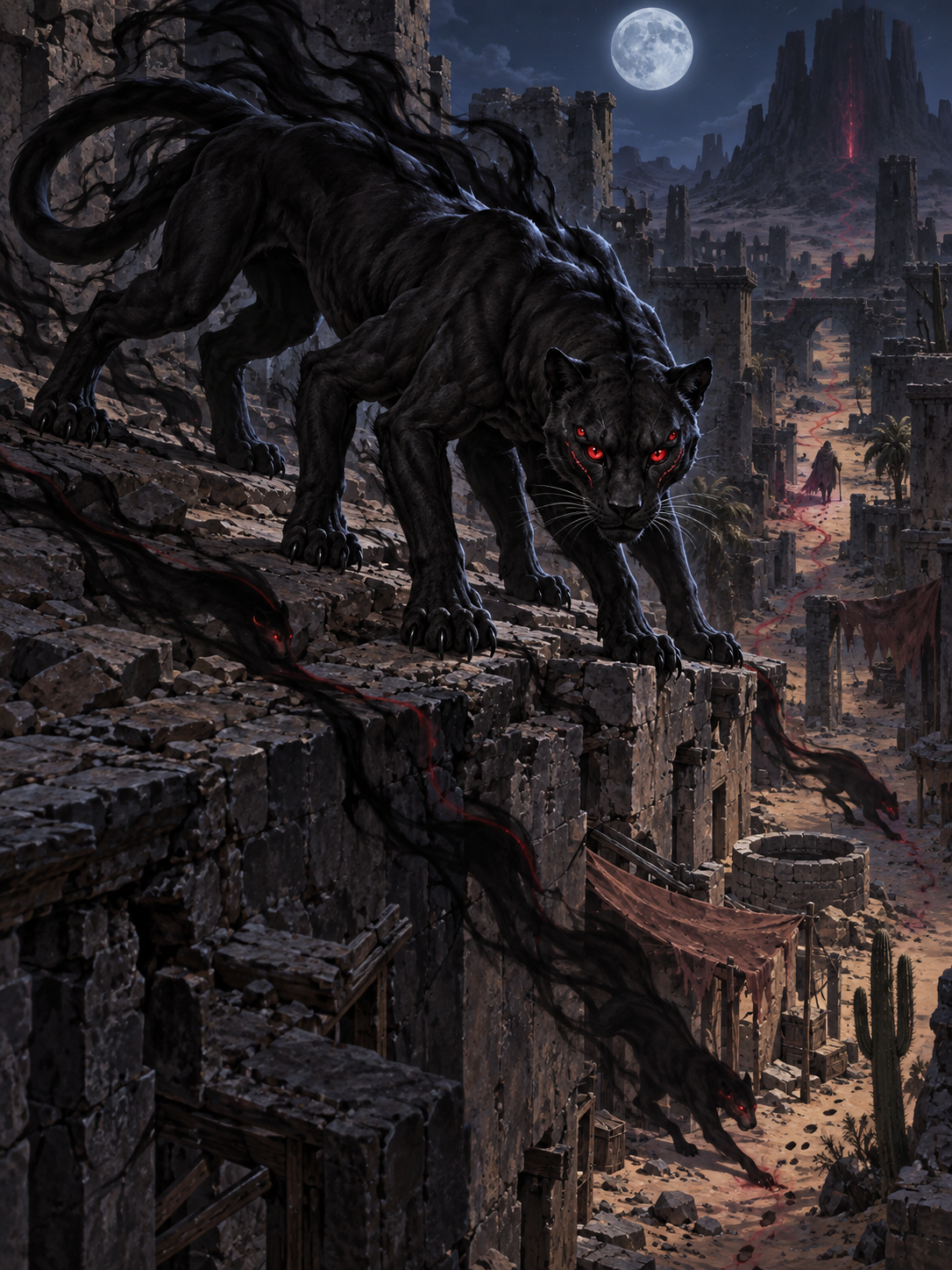
Blood Stalkers
Six-legged black predators that track biological identity after tasting blood rather than following scent.
A
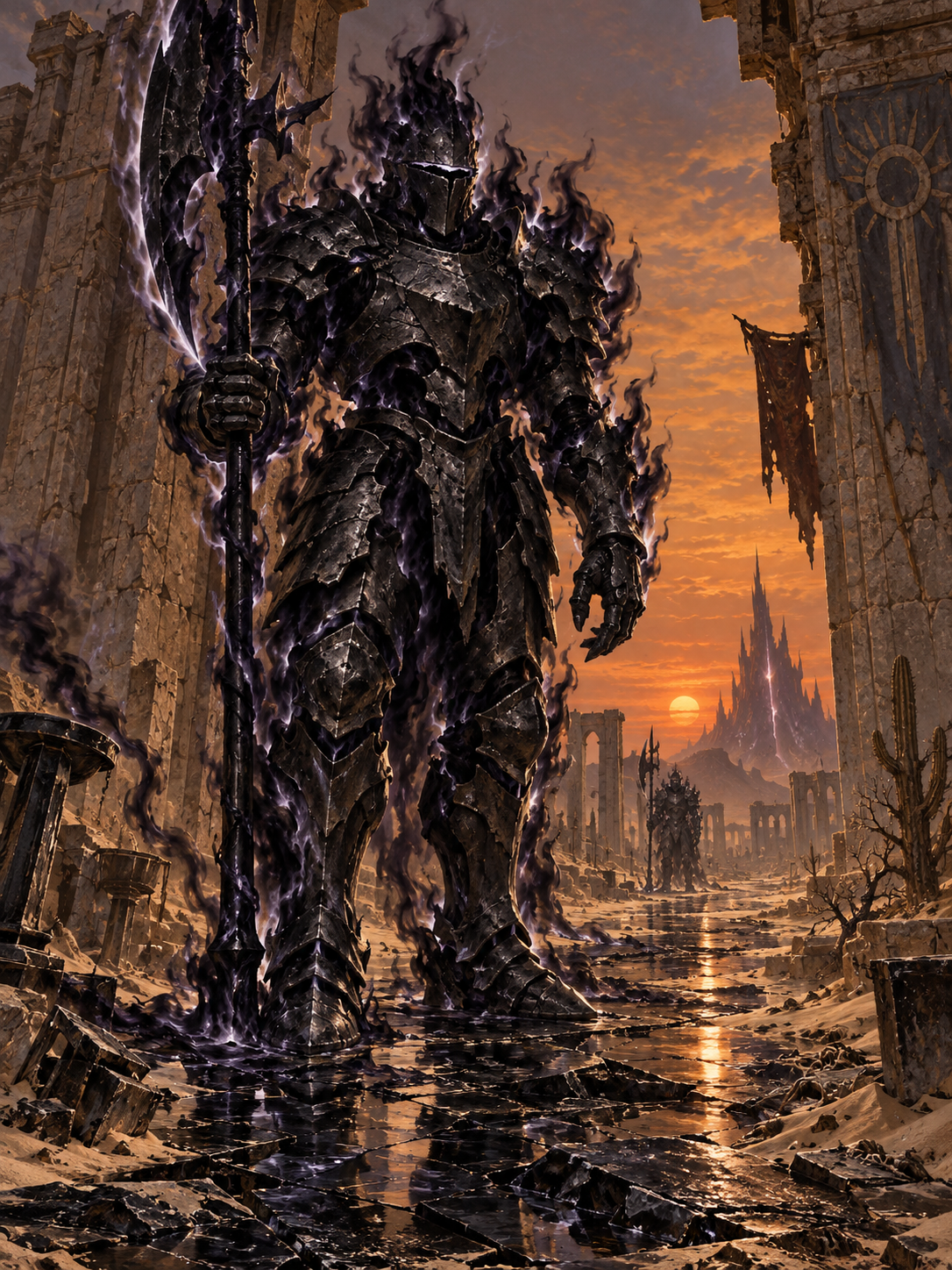
Flame Wardens
Hollow armored bodies of shadow-flame that claim thresholds and may wait decades for someone to cross.
B-ClassVeteran • Specialized response
B
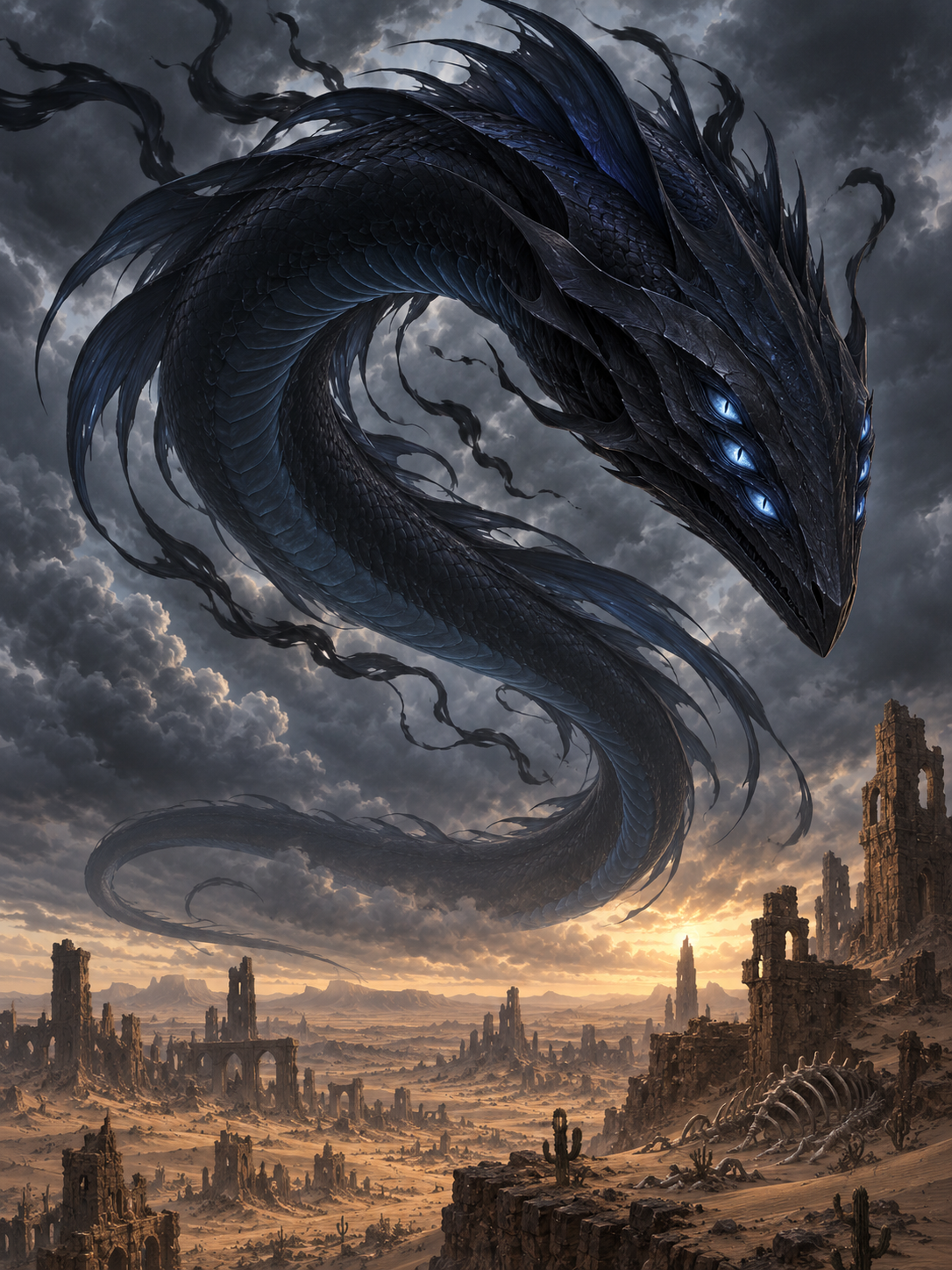
Sky Serpents
Six-eyed serpents that swim through air, creating pressure currents, violent winds, and storms.
B
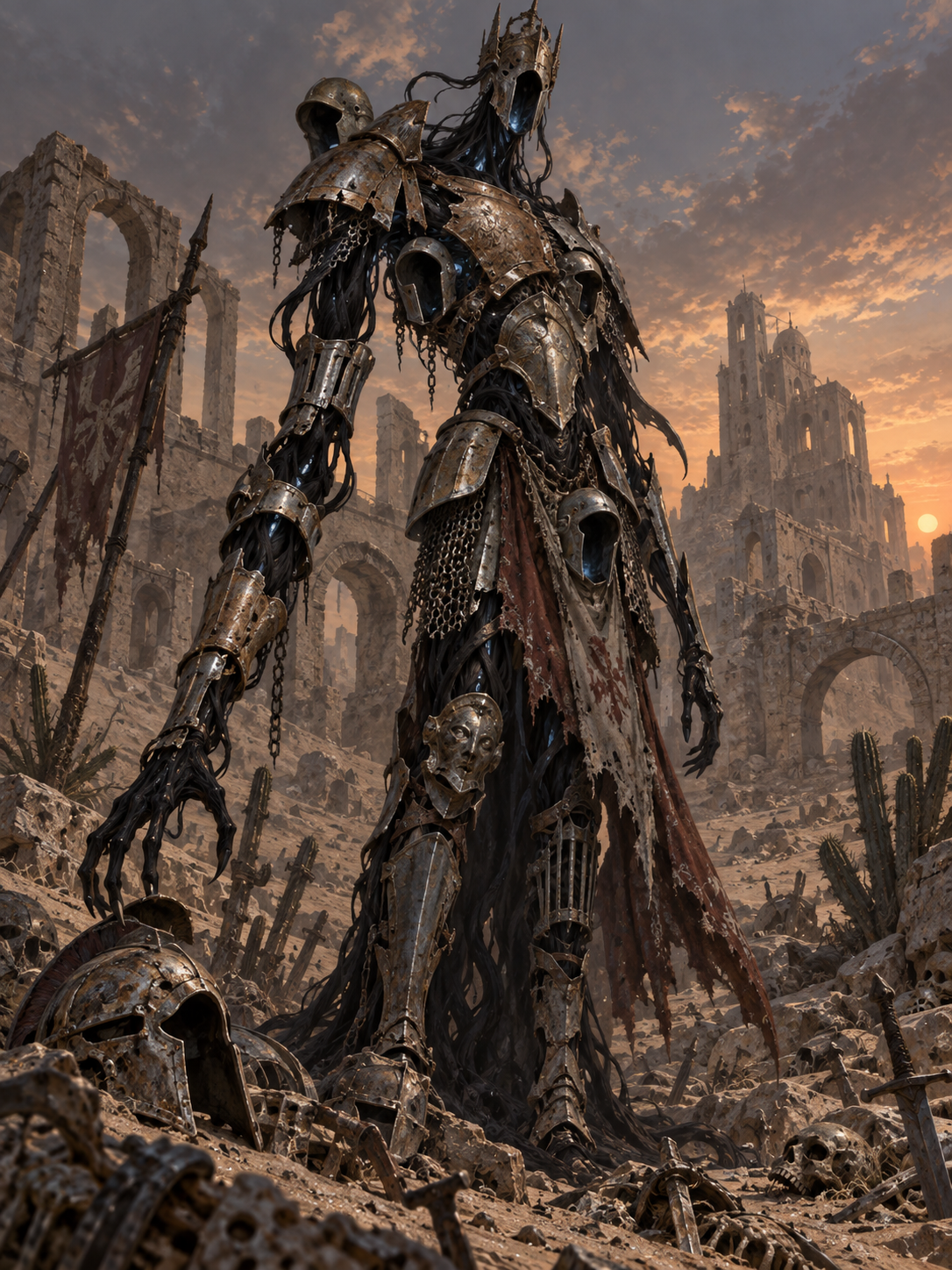
Iron Golems
Shadow organisms that gather discarded armor around themselves as shifting artificial skeletons.
Old Shadow Crawlers with several mastered identities may escalate from C-Class to B-Class.
C-ClassSerious • Localized threat
C
Gloom Beasts
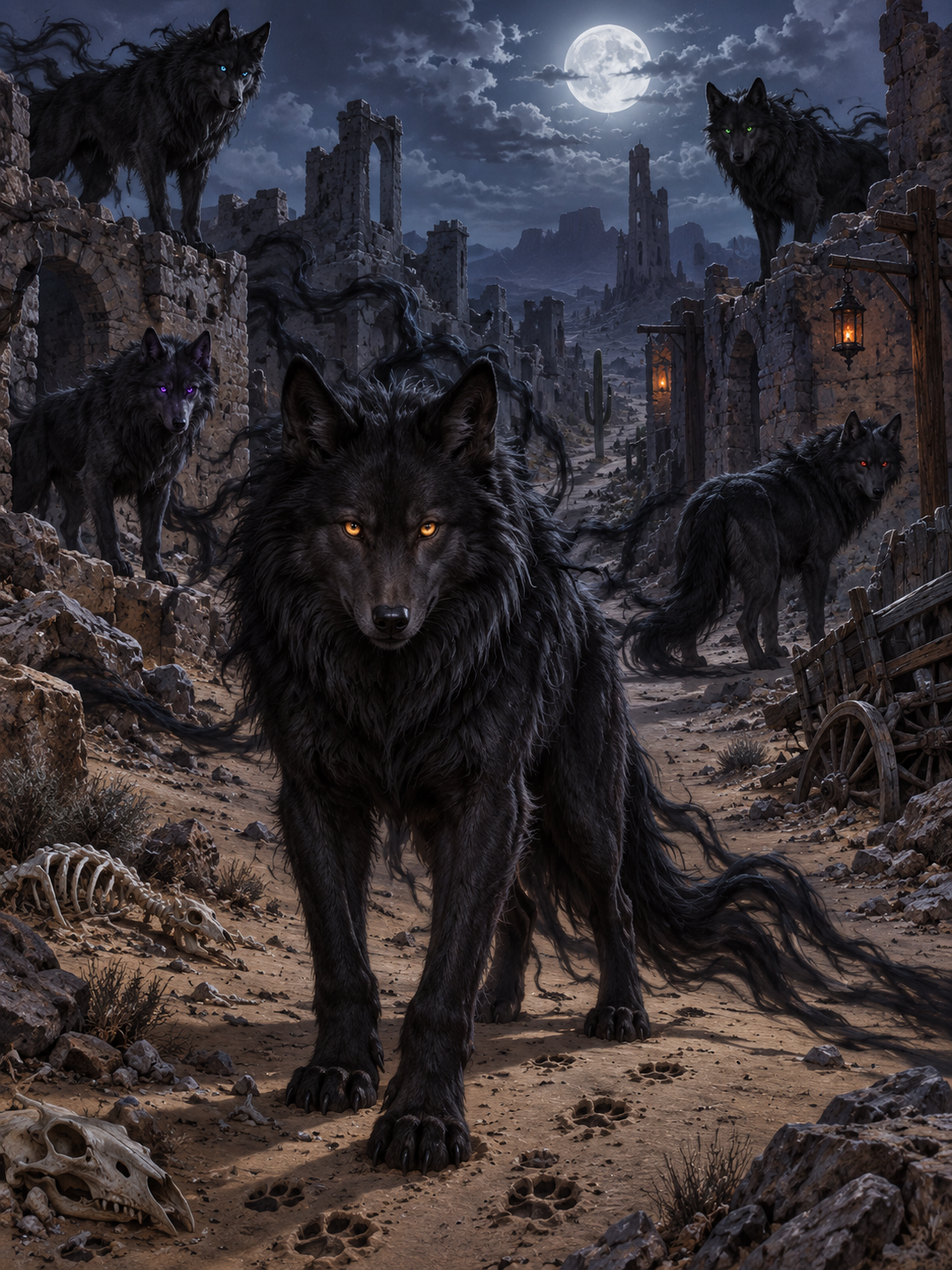
Intelligent wolf-like pack hunters whose shadows appear to communicate silently with one another.
C
Echo Witches
Living shadow forms that reproduce voices, footsteps, heartbeats, and sounds to create false positions.
C
Shadow Crawlers
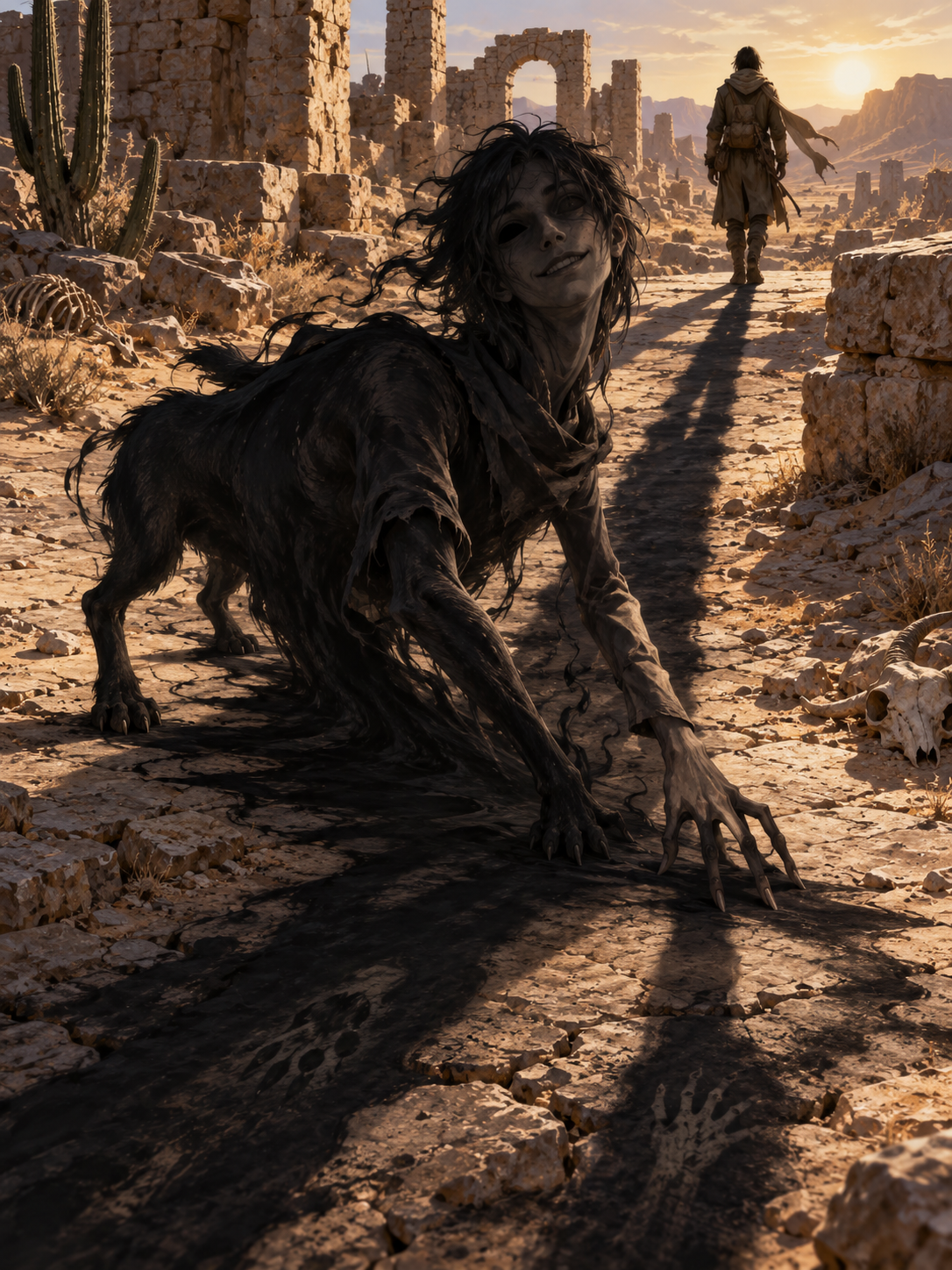
Shapeless mimics that travel through connected darkness and learn bodies, movement, and voices by observation.
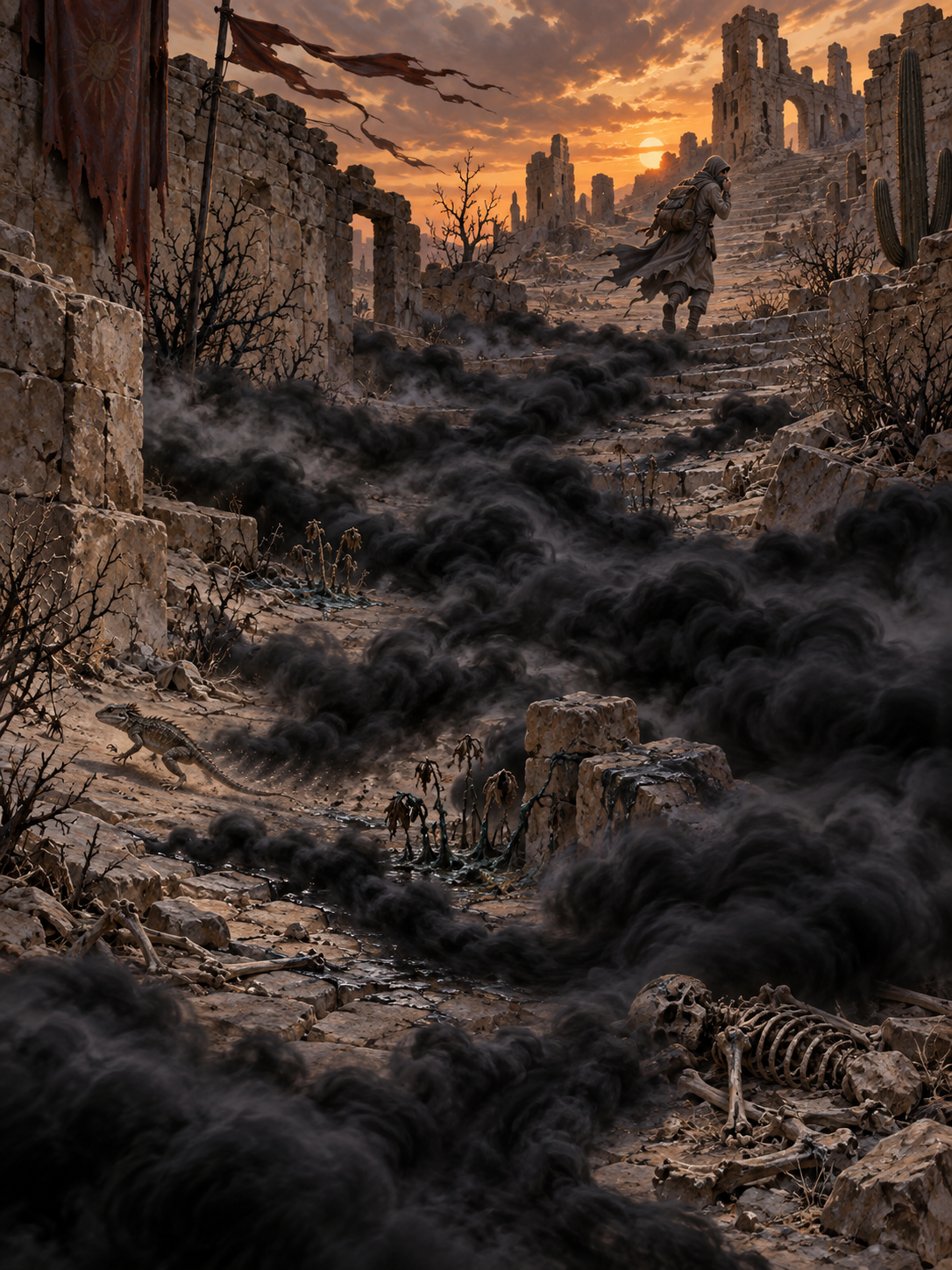
Multiple banks of Crawling Fog gathering into a Fog Tide may also reach C-Class.
D-ClassHazard • Containment required
D
Crawling Fog
Low black poison fog that moves against wind and gravity and reconverges toward living creatures.
Ordinary Crawling Fog is D-Class. A massed event becomes a C-Class Fog Tide.
E-ClassMinor • Sometimes harmless
E
Stink Bugs
Defensive scavengers that curl into armored discs and spray foul black-green oil when threatened.
E
The Hounds
Incorporeal shadow hounds that appear beside fast transports, race them, then vanish when satisfied.
Hounds are effectively harmless and are often considered good omens by Forsaken drivers. If it leaves pawprints, however, it probably is not a Hound.
Connection to the Star Lake
Seoul has not confirmed any known Other as the cause of the awakening surge, missing memories, forged trade network, or disturbances beneath the Star Lake. This archive records capabilities that investigators must consider. It does not identify a culprit.
Restricted: Intelligent Others
A small number of humanoid Others are capable of reason, communication, planning, and passing among Aetherian people. Some can exploit existing weaknesses between realities, reopening dormant rifts, widening small tears, delaying closure, or destabilizing damaged territory until another breach forms. They did not create the natural rift phenomenon, and they do not necessarily share a culture, motive, or allegiance. No humanoid Other has been publicly identified in connection with Seoul's current disturbances.